

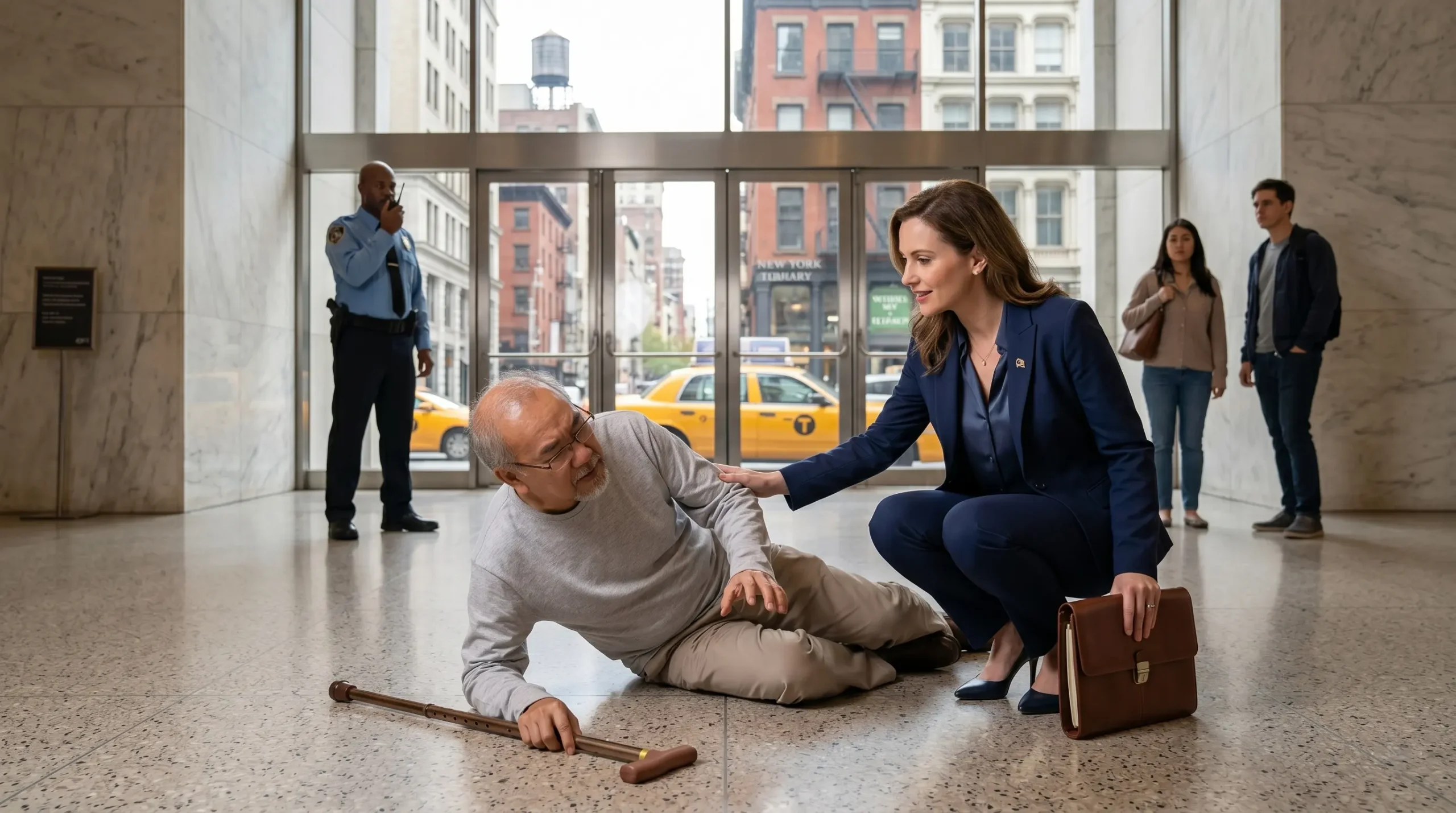
If you fell on a wet floor, a broken stair, or a cracked sidewalk in New York City, you may have a premises liability claim, and a New York slip and fall attorney at Silver Law Group can tell you in one free call whether it holds up. We handle slip and fall cases across all five boroughs: the Bronx, Brooklyn, Queens, Manhattan, and Staten Island. You pay no fee unless you recover. The consultation is free, we answer 24/7, and we speak English, Spanish, and Russian.
Do You Have a Slip and Fall Case in New York
Winning a slip and fall case means proving three things about the property owner: that they owed you a duty to keep the property reasonably safe, that they broke that duty, and that the break is what caused your injury. Get hurt on someone else’s property in New York and the law does not treat the owner as automatically at fault. A premises liability claim only works when all three elements line up, which is why two people can fall on the same staircase and only one of them has a case.
Most people who call us do not yet know who is responsible for their fall. That is normal. The at-fault party might be a store, a landlord, a cleaning contractor, or a city agency, and which one it is depends on facts you may not have while you are lying in an emergency room.
What You Must Prove: Notice and Causation
A hazard existing is not enough. You have to show the owner either created the dangerous condition or knew about it, or should have known, and did nothing to fix it in a reasonable time. Then you have to connect that condition to your fall: the torn mat, the unmarked wet floor, the missing handrail is what put you on the ground, not something unrelated.
That connection lives in evidence, and the useful evidence disappears fast. Surveillance video often gets recorded over within days or weeks. Maintenance and cleaning logs, incident reports, witness statements, and photos of the hazard before it is repaired are what turn “I fell” into “the owner failed to fix a spill they logged two hours earlier.” The sooner a slip and fall lawyer starts preserving that record, the more of it survives.
Actual Notice, Constructive Notice, and Created Hazards
New York recognizes three ways to pin knowledge of a hazard on the owner.
Actual notice means someone told the owner or the owner saw it. A tenant emails the super about a loose step and a week passes with nothing done.
Constructive notice means the hazard sat there long enough that a reasonable owner should have found and fixed it. A puddle of tracked-in rain that has been spreading across a lobby floor for an hour is a different case from one that appeared thirty seconds before you walked in.
Cause-and-create means the owner or an employee made the condition. A porter waxes a floor and leaves no warning sign, or a grocery stocker drops produce and walks away.
Which of these applies decides what evidence you need, so it shapes the case from the first day.
Who Is Responsible for a Slip and Fall in New York City
The defendant changes with the address. Fall in a store and the business owner is usually on the hook. Fall in the shared hallway or stairwell of an apartment building and it is the landlord’s responsibility for common areas. A commercial tenant can be liable when the tenant created the hazard inside its own leased space, a maintenance or construction contractor when its work caused the danger, and a government agency when you fell on public property it controls.
Naming the right party early matters because of what happens if you wait. File against the wrong defendant and you can blow a deadline against the right one. Video gets overwritten, the puddle gets mopped, the broken step gets replaced, and the store switches cleaning companies. A slip and fall lawyer works backward from the location to figure out who owed you the duty before that trail goes cold.
New York City’s Sidewalk Law (Administrative Code Section 7-210)
This one surprises people: if you trip on a cracked or raised public sidewalk in New York City, you usually sue the owner of the building next to it, not the City. Under NYC Administrative Code Section 7-210, enacted as Local Law 49 of 2003, the abutting property owner carries the duty to keep the sidewalk in reasonably safe condition and is liable when a defect hurts someone. That duty is non-delegable, so an owner cannot escape it by pointing at a managing agent or a snow-removal company.
There is one main exception. For owner-occupied homes of one, two, or three families used only as a residence, the City can still be the responsible party. Section 19-152 spells out what counts as an actionable defect, including a vertical height difference of half an inch or more between sidewalk flags. And when the City is the proper defendant, you generally cannot sue over a sidewalk unless the City had prior written notice of the defect under Section 7-201(c)(2), which is why those claims often turn on earlier DOT violations and 311 complaint records.
Snow, Ice, and the Storm-in-Progress Rule
New York City gives property owners a clock to clear snow and ice from the sidewalk once a storm ends, set by Administrative Code Section 16-123. The deadline depends on when the snow stops:
- Within 4 hours if it stops between 7:00 a.m. and 4:59 p.m.
- By 9:00 a.m. if it stops between 5:00 p.m. and 8:59 p.m.
- By 11:00 a.m. if it stops between 9:00 p.m. and 6:59 a.m.
The storm-in-progress rule cuts the other way. While snow or freezing rain is still falling, an owner is not required to clear it, so a fall during an active storm is much harder to pin on the owner than a fall on ice that sat untouched hours after the sky cleared. Timing is often the whole case.
Common Causes and Injuries in New York Slip and Fall Accidents
Most New York falls trace back to a short list of conditions that owners let slide. Common hazards include:
- Wet or freshly mopped floors with no warning sign
- Spills left in store aisles
- Broken or uneven stairs and missing handrails
- Poor lighting in stairwells and entryways
- Cracked or raised sidewalk flags and tree-root uplift
- Faulty repairs that create a new hazard
- Snow and ice left uncleared past the legal deadline
- Subway stairs and transit-station platforms in disrepair
The injuries are rarely minor. A hard fall onto concrete or tile can cause broken bones, traumatic brain injury from the head striking the ground, spinal cord injury, and soft-tissue damage that keeps you out of work for months. Older adults break hips and wrists that never fully heal. What looks like a bruise on the day can turn into surgery weeks later, which is one reason a prompt medical exam matters as much for your health as for your claim.
What a Slip and Fall Case Is Worth in New York
No lawyer can put a number on your case from a phone call, and anyone who does is guessing. Value turns on how badly you were hurt, how strong the evidence of the owner’s fault is, and how much of the blame lands on you.
New York lets you recover two broad categories. Economic damages cover hard costs with receipts behind them: medical bills, the price of future care and surgery, lost wages, and lost earning capacity if the injury changes what you can do for work. Non-economic damages cover pain and suffering, the part with no invoice. In rare cases involving egregious conduct, punitive damages may be available, and New York sets no statutory cap on them, though courts award them sparingly.
What we will not do is quote you an average or promise a figure. Those numbers mislead people, and every case stands on its own facts.
What If You Are Partly at Fault
You can still recover money even if the fall was partly your fault. New York follows pure comparative negligence under CPLR Section 1411, which reduces your award by your share of the blame instead of barring you from recovery.
Say you were looking at your phone when you tripped on a broken step the landlord had ignored for a month. A jury might assign you 30 percent of the fault. Under the rule, you still collect 70 percent of your damages. Even at 90 percent your fault, the remaining 10 percent is yours to recover. Insurers lean hard on comparative fault to shrink what they pay, which is why how the fall gets described in the early days matters so much.
What to Do After a Slip and Fall in New York
What you do in the first hours shapes the case more than almost anything a lawyer does later. If you are able:
- Get medical care promptly, even if you think you can walk it off.
- Photograph the hazard and the scene before anyone repairs or cleans it.
- Ask the manager or building for a written incident report, and get a copy.
- Collect names and phone numbers of anyone who saw you fall.
- Keep the shoes and clothes you were wearing, unwashed, in a bag.
- Do not give a recorded statement to the insurer or sign anything they send.
DOT sidewalk-violation records and 311 complaint history can be pulled later to show the hazard was reported before your fall, so even if you missed the moment, the case is not necessarily lost. A fall injury lawyer can request those records once you are represented.
What It Costs to Hire a New York Slip and Fall Lawyer
Nothing upfront. Silver Law Group takes slip and fall cases on a contingency fee, which means you pay no hourly rate and no retainer to get started. Our fee is a percentage of what we recover for you, taken out of the settlement or verdict at the end. If we do not win your case, you owe us no attorney’s fee at all. That arrangement puts the risk on the firm, not on an injured person already worried about rent and medical bills.
The first conversation costs nothing either. Every slip and fall case starts with a free consultation, and there is no obligation to hire us afterward.
How Long You Have to File a Slip and Fall Claim in New York
Miss the deadline and it does not matter how strong your case was. For most falls on private property, CPLR Section 214 gives you three years from the date of the injury to file a lawsuit.
Claims against the government run on a much shorter clock. If you fell on property controlled by the City or an agency like NYCHA or NYC Transit, or on a public sidewalk the City is responsible for, General Municipal Law Section 50-e requires a Notice of Claim within 90 days of the fall, and Section 50-i sets the lawsuit deadline at one year and 90 days. Blow the 90-day notice and the whole claim can be gone before you ever reach a courtroom.
Two more timelines matter. When a fall causes a death, EPTL Section 5-4.1 gives the family two years from the date of death to bring a wrongful death claim. And when the injured person is a minor, the deadlines are generally tolled, though the Notice of Claim rules against the government still demand fast action. Because these clocks vary this much, the safest move is to have a lawyer confirm your specific deadline early.
Boroughs We Serve Across New York City
Silver Law Group handles slip and fall claims in all five boroughs. New York’s premises liability law and the NYC sidewalk rules are identical across the five boroughs, but the courts, venues, and street conditions differ, so each borough has its own page:
- Manhattan
- Brooklyn
- Queens
- The Bronx
- Staten Island
If your fall happened in a specific borough, start with that page for the local courts and details, then call us to talk about your case.
Why Choose Silver Law Group for Your New York Slip and Fall Case
You are choosing a firm while an adjuster is already working to close your claim cheap. Here is what Silver Law Group puts on your side.
The consultation is free and you pay no fee unless we recover for you. We answer around the clock, so you are not waiting until Monday for advice after a Saturday fall. We handle consultations in English, Spanish, and Russian. We prepare every case as if it will go to trial, which is the posture insurers respect when they decide what your claim is worth. And if your injury keeps you home or in a hospital bed, the attorney comes to you.
Our office is at 49 West 37th Street, 7th Floor, New York, NY 10018, in Midtown Manhattan. Call 212-470-4544 to talk with a New York slip and fall attorney today.