

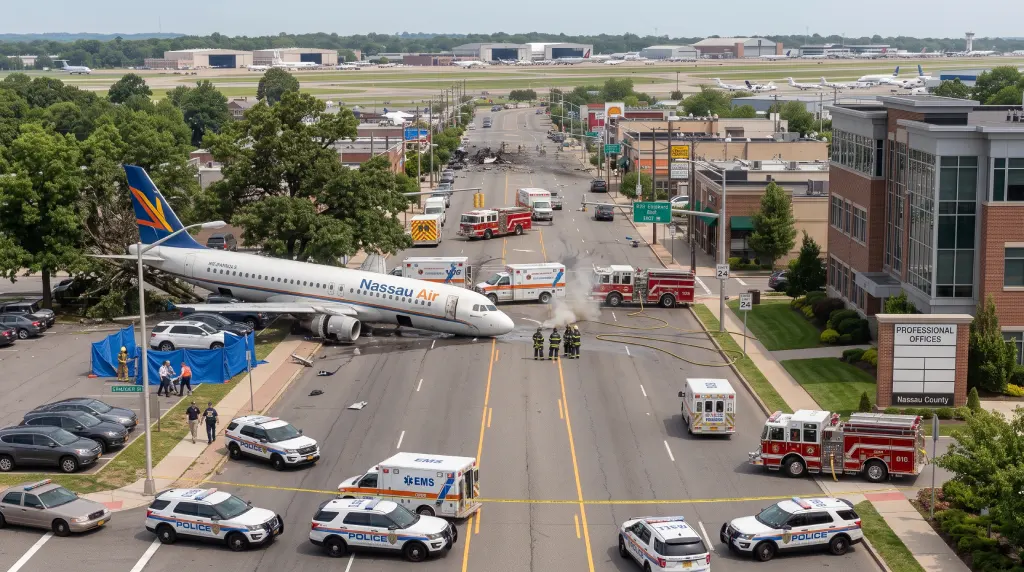
A Nassau County aviation accident lawyer at Silver Law Group represents people hurt in plane and helicopter crashes on Long Island, along with families who lost someone in a crash. The moment you or a relative is injured in an aviation accident, powerful parties start protecting themselves — the airline, the charter operator, their insurers, and the manufacturers whose parts may have failed. You should have someone doing the same for you.
The firm reviews what happened at no charge and tells you plainly whether you have a claim. Consultations are free, available 24 hours a day, and offered in English, Spanish, and Russian. If your injuries keep you home or in a hospital bed, the attorney comes to you.
Silver Law Group prepares every case as if it will be tried, because airlines and their insurers settle differently with a lawyer who is ready to put the case in front of a jury. You pay nothing up front and owe no legal fee unless the firm recovers for you. Call 212-470-4544 to talk through your aviation accident today.
Do You Have an Aviation Accident Claim
You have a claim only when someone’s negligence caused your crash, and New York makes you prove it in four parts: that a party owed you a duty of care, that they broke it, that the breach caused the crash, and that you were hurt as a result. A pilot who flew into weather he was told to avoid broke a duty. A mechanic who signed off on a cracked rotor part broke one too.
The hard part is rarely the injury. It is finding who is responsible, because aviation accidents usually have more than one cause. Investigators often trace a single crash to a pilot decision, a maintenance shortcut, and a design flaw that lined up at the worst moment. Each of those points to a different defendant, and each may carry its own insurance.
Depending on what caused your crash, the parties who may owe you money include:
- The airline or carrier, for the conduct of its crew and the training behind it
- The pilot, for errors in judgment or violations of flight rules
- The charter operator that arranged and ran the flight
- The aircraft or parts manufacturer, when a design or component failed
- The maintenance contractor that serviced or inspected the aircraft
- The fixed-base operator (FBO) that fueled, stored, or handled the plane
- The airport operator, for hazards on runways or taxiways
- Air-traffic control, when a controller’s instruction contributed to the accident
Sorting out which of these caused your injury takes the flight records, the maintenance logs, and often the federal investigation file. A lawyer requests and reads those before the evidence is gone.
Types of Aviation Accidents We Handle
Silver Law Group takes on the full range of aircraft, not only commercial jetliners. The mechanics of a crash, and the law that governs it, change with the type of flight.
- Commercial airline crashes, including hard landings, runway excursions, and turbulence injuries on scheduled carriers
- Charter plane crashes, where a private company arranged the flight and its safety record and operator decisions come under scrutiny
- Private jet and small private plane accidents, which the data shows carry higher risk than scheduled airline travel
- Helicopter accidents, from mechanical and rotor failures to hard landings and controlled flight into terrain
- Medevac and air-ambulance crashes, where a patient already in crisis is hurt further
- Seaplane accidents on Long Island’s waters and shorelines
Much of Nassau’s private and rotor traffic moves through Republic Airport, which sits on the Nassau-Suffolk border in East Farmingdale and runs heavy charter and helicopter operations. Flights out of a general-aviation field like Republic put small planes and helicopters over dense Long Island neighborhoods, and a failure on takeoff or approach leaves little room to recover. When one of those flights goes wrong, the case often turns on the operator’s maintenance and the pilot’s training rather than on any airline.
If your aircraft is not on this list, call anyway. The firm has handled unusual aviation accidents, and the question is always the same: what failed, and who was responsible for keeping it from failing.
Common Aviation Accident Injuries
The forces in an aircraft crash — sudden deceleration, fire, and blunt impact inside a small cabin — tend to be more severe than a car wreck. The injuries the firm sees most often:
- Traumatic brain injury, from the head striking cabin structure or from rapid deceleration alone, which can change memory, mood, and the ability to work
- Spinal cord damage and paralysis, when the vertebrae take a vertical load in a hard landing
- Burns, from fuel fires and hot surfaces, which often need repeated surgeries and leave lasting scars
- Fractures of the legs, hips, and pelvis, common when a seat collapses or the floor buckles
- Internal injuries and bleeding, which may not announce themselves right away
That last point matters after any hard landing, even one everyone walked away from. A brain bleed or a torn organ can stay quiet for hours or days while it worsens, and adrenaline masks pain at the scene. A passenger who feels shaken but intact can be seriously hurt.
Get a full medical evaluation the same day, and go back if new symptoms appear: a headache that deepens, dizziness, belly pain, numbness. The record a doctor creates now becomes the backbone of your claim later, and a gap between the crash and your first visit is the first thing an insurer will use to argue you were not really hurt.
Domestic vs. International Flights and the Montreal Convention
A domestic flight and an international flight are governed by different bodies of law, and the gap between them is large. A crash on a flight that began and ended inside the United States runs on ordinary New York negligence law: you prove fault, and your recovery is not capped.
An international flight is governed instead by the Montreal Convention, a treaty that replaces state negligence rules for travel between countries. The Convention sets up two tiers of airline liability. For proven damages up to 151,880 Special Drawing Rights, the international currency unit the treaty uses instead of any national currency, the airline is strictly liable, meaning you recover within that first tier without proving the carrier did anything wrong. Above that amount, the airline can avoid further liability only by proving it was not negligent, which puts the burden on the carrier rather than the injured passenger.
The Convention also carries its own clock. Article 35 gives you two years from the date the aircraft arrived, or should have arrived, to bring your claim, and courts apply that deadline strictly. It is shorter and less forgiving than New York’s three-year injury statute, and it is not paused by the same events that can extend a domestic case. Which regime applies is not always obvious on a connecting itinerary, so a lawyer pins that down before any deadline runs.
What Your Aviation Accident Case Is Worth
No lawyer can put a number on your case in the first phone call, and you should be wary of one who tries. What the firm can tell you is what New York lets you recover after an aviation accident:
- Medical costs, from the first ambulance and hospital stay through future surgeries, therapy, and long-term care
- Lost earnings, including wages you missed and the income you can no longer earn if the injury changed what work you can do
- Pain and suffering, for the physical pain, disability, and mental harm the crash caused
- Wrongful-death losses, when a passenger dies, covering the survivors’ loss of support, services, and a parent’s guidance to children
New York also protects your claim even if you were partly at fault. Under CPLR 1411, the state follows pure comparative negligence: your recovery is reduced by your share of the blame, but it is never barred. If a jury finds your damages and assigns you a percentage of fault, the court subtracts that percentage and you keep the rest. Say a passenger ignored a crew instruction and a jury put ten percent of the fault on him; he still recovers the other ninety percent.
That rule matters most when an insurer tries to pin the crash on the victim to pay nothing. Pure comparative negligence takes that all-or-nothing threat off the table, and it is one reason the medical and factual record you build from day one carries so much weight.
What to Do After a Nassau Aviation Accident
The hours and days after a crash shape what you can recover later. A few concrete steps protect your claim:
- Get medical treatment and keep going back. Follow every referral, fill every prescription, and report new symptoms. Gaps in care are the first thing an insurer attacks.
- Keep your boarding pass, ticket, itinerary, and any booking emails. They prove you were on the flight and pin down whether it was domestic or international, which sets your deadline.
- Say nothing recorded to the airline or its insurer. An adjuster may call within days, friendly and sympathetic, asking for a quick statement. A recorded account given while you are medicated and shaken can be twisted to cut or deny your claim, and you are not required to give one.
- Understand that the NTSB and FAA will investigate the cause. Their inquiry is not your lawsuit, it can take a year or more, and its findings are handled under specific rules in court. You do not wait for it to protect your own rights.
- Call a lawyer early. Aircraft wreckage, maintenance logs, and flight data get preserved, moved, or overwritten fast, and a lawyer can act to secure that evidence before it disappears.
Do these in whatever order your health allows, but treat the medical care first. Everything else in your case is built on the treatment you get now.
Deadlines to File a Nassau Aviation Claim
New York gives you a set amount of time to sue, and the clock is already running. Miss the deadline that applies to your case and the court throws it out no matter how badly you were hurt.
For an injury claim, CPLR 214 sets a three-year limit from the date of the crash. A Nassau resident’s aviation accident suit is filed in Nassau County Supreme Court in Mineola, and filing after three years ends the case before its facts are ever heard.
When a passenger dies, the wrongful-death claim runs on a shorter clock. EPTL 5-4.1 gives the family two years from the date of death to bring it. The two-year death deadline and the three-year injury deadline can both apply to the same crash, and they are counted from different dates.
A government-owned airport or operator adds an earlier trap. If a public entity, such as a county airport authority, is a responsible party, General Municipal Law 50-e requires a formal Notice of Claim within 90 days of the accident before you can sue that entity at all. Ninety days passes fast while you are still in treatment, and missing it can bar a claim you otherwise had. International flights carry the separate two-year Montreal Convention deadline described above. Because more than one clock can run at once, have a lawyer identify every deadline early and file to the shortest one.
Why Nassau Families Choose Silver Law Group
You pay Silver Law Group nothing to start and nothing along the way. The firm works on a contingency fee, which means its fee is a percentage of what it recovers for you and comes out only if it wins or settles your case. If there is no recovery, you owe no legal fee. The costs of building the case, from investigators and flight-data analysis to expert witnesses, are advanced by the firm rather than billed to you as you go. That lets a family with a hospital bill and a lost paycheck hire the same caliber of representation the airline already has.
Every aviation accident case is prepared for trial from the start. Carriers and their insurers track which lawyers actually try cases and weigh settlements accordingly. If your injuries or grief keep you from an office, the attorney travels to your home or hospital room.
Consultations are free, available 24 hours a day, and handled in English, Spanish, or Russian. Call 212-470-4544 to speak with a Nassau County aviation accident lawyer and find out where you stand.