

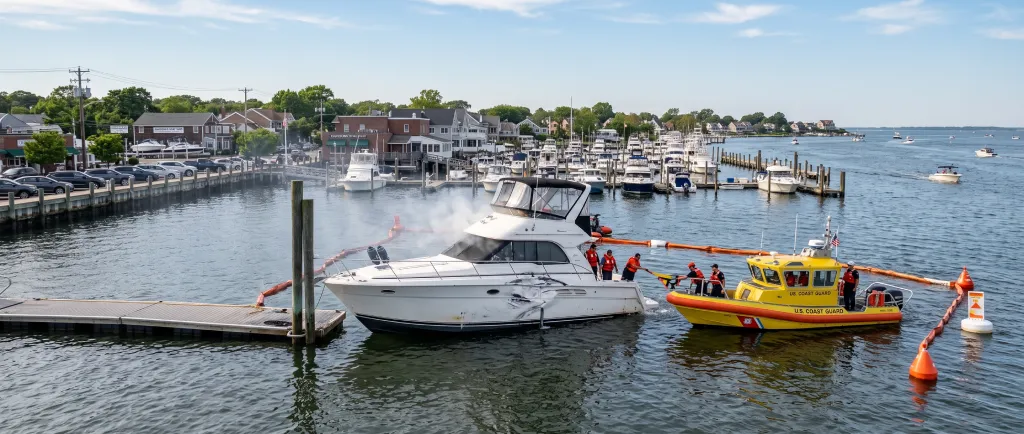
A boat crash on Nassau County water leaves you with problems a highway collision never does: no report waiting at a precinct, an operator who may carry no insurance at all, and rules that change depending on whether you were hurt in Hempstead Bay or on an inland lake. A Nassau County boat accident lawyer at Silver Law Group builds your claim around those differences instead of forcing it into the shape of a car case. We represent people hurt on Long Island’s South Shore canals and Sound-side bays, from passengers and swimmers to the operators themselves, and we prepare every case as if it will be tried. Your first consultation costs nothing, and we hold it in English, Spanish, or Russian, at any hour. If pain or a hospital stay keeps you home, an attorney comes to you. Call 212-470-4544.
Where Boat Accidents Happen in Nassau County
Most Nassau boat injuries cluster in a handful of crowded summer waterways, and the crowding is the problem. Freeport’s Nautical Mile draws boaters to the restaurants and docks along the Woodcleft Canal, where narrow lanes force powerboats, launches, and pedestrians into the same tight space. Just south, Reynolds Channel carries heavy traffic between the mainland and the barrier beaches, and its current and boat wakes catch inexperienced operators off guard.
Point Lookout and the Jones Beach boat channel see swimmers and anchored vessels sharing water with boats moving too fast for the conditions. Hempstead Bay, shallow and busy on weekends, produces grounding and wake collisions when operators misread the depth. On the North Shore, Manhasset Bay and Oyster Bay fill with sailboats, tenders, and larger cruisers whose paths cross near mooring fields and marina entrances.
Long Beach rounds out the map, with its inlet traffic and the swimmers who share the same water. What these places have in common is volume: peak-season congestion in confined channels, mixed craft that handle nothing alike, and a lot of people who took the boat out for the first time that season. When a collision or a wake-throw injury happens on any of them, where it happened decides which court hears the case and which law governs it.
Do You Have a Case? Who Can Be Held Liable
You have a case when someone’s careless operation or upkeep caused your injury and you can prove it. New York negligence runs on four parts: the person owed you a duty of reasonable care on the water, they breached it, that breach caused your injury, and you have real losses because of it. On a boat, the duty is concrete — a sober, attentive operator running at a safe speed, keeping a proper lookout, and following the navigation rules.
More than one party is often on the hook. Depending on how your crash happened, the responsible party may be any of these:
- The operator who was drunk, speeding, distracted, or simply untrained
- The boat owner who lent an unfit vessel or let an unqualified person drive it
- A rental or charter company that skipped a safety briefing, handed over a boat with bad equipment, or rented to someone with no certificate
- A marina whose fuel dock, mooring, or repair work created the hazard
- A manufacturer whose defective throttle, hull, or steering failed
- A ferry operator carrying passengers across Nassau waters
- A government body running a public or patrol vessel
Naming every liable party matters because it opens more than one insurance policy, and a boat owner’s own coverage is often thin.
New York follows pure comparative negligence under CPLR 1411, which changes the math in your favor. Even if a jury finds you partly at fault — say you were 30% responsible for standing where you did — you still recover the other 70%. There is no cutoff. A plaintiff found mostly at fault still collects the share tied to the other side’s fault, so the insurer’s early claim that the crash was “your own doing” does not end your case the way it might in a state with a stricter bar.
Maritime Law vs. New York Law on Nassau Waters
Which law governs your claim depends on the water you were hurt on, and the line runs between navigable and non-navigable water. Long Island Sound, the South Shore bays, the channels that connect to the ocean, and the Atlantic itself are navigable waters of the United States. An injury there falls under federal maritime law, tried in either federal court or state court under maritime rules. Maritime law brings its own doctrines — the duty owed to passengers, the rules for crew, and remedies a state court would not apply to a car crash.
An inland lake or pond with no channel to the sea is different. A crash on that kind of water is a New York State case, governed by the state statutes that control any personal injury claim.
For most Nassau boaters, the water is maritime. Freeport’s canals, Reynolds Channel, Hempstead Bay, and the Sound all connect to the ocean, so a claim from any of them likely runs under federal maritime rules. That carries a hard deadline: 46 U.S.C. 30106, the maritime statute of limitations, gives you three years from the date of injury to file. It is a federal clock, and it runs whether or not you also have a state-law claim. The reason to sort this out early is that maritime and state deadlines do not always match, and filing in the wrong court under the wrong rule can cost you the claim.
Common Causes of Nassau Boating Accidents
Alcohol leads the list, and New York treats it much the way it treats drunk driving. Under Navigation Law 49-a, operating a vessel with a blood alcohol level of 0.08 or higher is boating while intoxicated, a crime — and a near-automatic sign of negligence in your injury claim. The other leading causes turn up again and again in Nassau crashes:
- Operator inexperience. Someone rents or borrows a boat for a summer weekend without knowing how it handles.
- Excessive speed for a crowded channel or low-visibility conditions.
- Distracted operation, when a phone, a drink, or passengers pull the operator’s eyes off the water.
- Overloading that makes a boat ride low, swamp, or capsize.
- Wake collisions, where one boat’s wake throws a passenger on another vessel or slams a smaller craft.
- Equipment failure from skipped maintenance: dead navigation lights, worn steering, a throttle that sticks.
Wake injuries deserve special mention, because operators rarely think they caused one. New York holds an operator responsible for the damage their wake does, even after their boat has passed. On a packed summer day in Reynolds Channel or off Point Lookout, a single careless throttle can hurt someone two boats away.
Serious Boating Injuries We Handle
The injuries that bring people to us tend to be severe, because water removes the protections a car offers. Drowning and near-drowning are the gravest, since a near-drowning survivor can suffer permanent brain damage from minutes without oxygen. Traumatic brain injury also comes from a hard fall against a deck or a hull, or from being thrown in a collision.
Spinal cord damage follows the same violent falls and can leave lasting weakness or paralysis. Propeller injuries are their own category: a spinning prop causes deep, repeated lacerations that often need surgery and leave nerve and muscle damage behind. Hypothermia sets in faster than people expect, even in summer water, and it worsens every other injury by slowing the body during rescue.
Get checked the same day, even if you feel able to walk away. Mount Sinai South Nassau in Oceanside is the closest trauma-capable hospital for much of the county, and the record a doctor creates there becomes the backbone of your claim. Cold-water and head injuries in particular can hide for hours, and a gap between the crash and your first exam is the first thing an insurer will use against you.
Brianna’s Law and Operator Safety Violations
Since January 1, 2025, every person operating a motorized vessel in New York must hold a state Safe Boating Certificate, regardless of age. That is the final phase of Brianna’s Law, named for a girl killed in a boat crash, and it closed a long gap that once let almost anyone start an engine without training.
The certificate rule matters to your case for a direct reason. An operator running a boat without the required certificate has broken a safety statute, and that violation is strong evidence of negligence. It shows the person was on the water without the basic training the law now demands. Pair an uncertified operator with alcohol, speed, or a wake injury, and the picture of a careless operator gets much harder for an insurer to argue against.
When we take your case, one of the first things we check is whether the operator held a valid certificate at the time of the crash. If they did not, that fact goes to the center of the claim. The same applies to a rental or charter outfit that handed a boat to someone with no certificate on file, because they were required to check.
What Your Nassau Boat Accident Claim Is Worth
What a boat claim is worth turns on your losses, not a formula, and boat claims work differently from car claims in a way that helps you. Your recovery can include three kinds of damages.
Economic damages cover the money the crash costs you: emergency treatment, surgery, rehabilitation, future medical care, lost wages, and lost earning power if an injury keeps you from your job. These are the losses you can document with bills and pay records.
Non-economic damages cover what has no receipt — physical pain, the mental toll, scarring from a propeller injury, and the activities you can no longer do. On serious injuries, this part of the claim is often larger than the medical bills.
Punitive damages are rarer and aim to punish, not just repay. A court may award them when the operator’s conduct was reckless rather than merely careless, such as running a packed channel drunk and at full speed. They are not available in every case, but egregious boating conduct is the kind that can support them.
Here is the difference that surprises most people. New York’s no-fault system does not apply to boats. There is no boat PIP paying your first medical bills the way car no-fault does, and the serious-injury threshold in Insurance Law 5102(d) — the barrier that forces car-crash victims to prove a qualifying injury before they can sue for pain and suffering — does not apply to a boat claim at all. You do not have to clear that threshold. You can pursue full pain-and-suffering damages from the start, without the hurdle that limits so many car cases. That single distinction often makes a boat claim worth pursuing where a similar car claim would stall.
What to Do After a Nassau Boat Accident
The hours after a boat crash decide how strong your claim will be. Work through these steps in order as soon as you are safe.
- Get medical care first. Let EMS check you at the dock or go to the hospital, even if you think you are fine. Cold-water and head injuries hide, and the medical record starts here.
- Report the crash. Call the marine police unit and tell the marina. New York requires operators to report boating accidents that involve injury, and an official report is evidence you will want later.
- Photograph everything. Shoot the boats, the damage, the water conditions, registration numbers, and any visible injuries before anyone moves the vessels.
- Collect the details. Get the operator’s name, address, boat registration, and insurance information, plus the rental or charter company if there was one.
- Preserve witnesses. Other boaters and people on the dock scatter fast. Get names and phone numbers before they leave.
Do not give a recorded statement to any insurer before you talk to a lawyer. The adjuster who calls in the first days is building a file to pay you less, and an offhand remark on that call can follow your case to the end.
Deadlines to File a Nassau Boat Accident Claim
A boat claim in Nassau runs on more than one clock, and the shortest one that fits your case is the one that controls. Miss it, and the strongest claim in the world is dead.
For a standard injury claim under New York law, CPLR 214 gives you three years from the date of the crash to file suit. That lines up with the federal maritime deadline of three years under 46 U.S.C. 30106, so most Nassau boat injuries share a three-year window whether they proceed under state or maritime law. Three years feels like a long time until you count the months lost to treatment and back-and-forth with an adjuster.
If someone died in the crash, the deadline is different and shorter. EPTL 5-4.1 gives the estate two years from the date of death to bring a wrongful-death claim. It is a separate action from any injury claim, and the two-year clock is easy to overlook while a family is grieving.
The shortest deadline of all applies when a public or municipal vessel is involved — a government patrol boat, a municipal ferry, or another government-run craft. Before you can sue a public entity, GML 50-e requires you to file a formal Notice of Claim within 90 days of the crash. Ninety days. Miss that notice and you generally lose the right to sue the public defendant at all, no matter how strong your injury claim would have been.
Because a single crash can trigger a 90-day notice, a two-year wrongful-death clock, and a three-year injury deadline at once, the safe move is to have a lawyer sort out which clocks apply within days, not months.
Why Choose Silver Law Group
You pay us nothing up front, and nothing at all unless we win. Silver Law Group works on a contingency fee, which means our fee is a percentage of what we recover for you and comes out only when money comes in. If we recover nothing, you owe us no attorney’s fee. That arrangement lets you hire a trial-ready firm while you are out of work and worried about bills, without writing a check to do it.
We prepare every boat case as if it is going to trial, because insurers settle seriously only when they believe you will see them in court. That posture shapes the whole claim, from how we gather evidence to how we handle the adjuster.
You can reach us any hour, and your free consultation is available in English, Spanish, or Russian. If a hospital stay or your injuries keep you from our Midtown Manhattan office at 49 West 37th Street, an attorney will come to your home or your hospital room instead.
Start with a free consultation. Call 212-470-4544, any day, any time.