

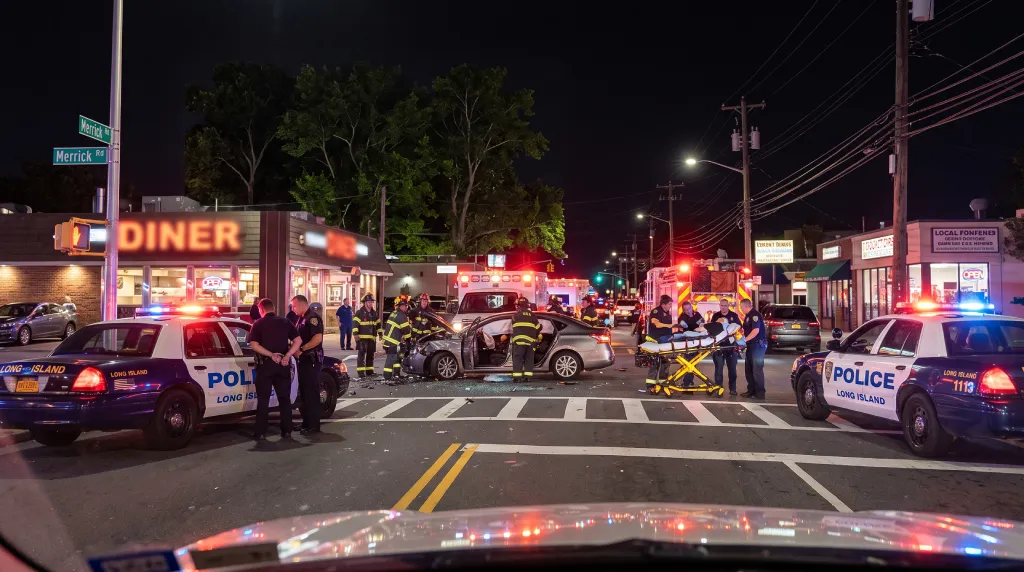
If a drunk driver hurt you or someone in your family on a Nassau County road, Silver Law Group represents you. As a Nassau County drunk driver accident attorney, we handle the civil injury claim that runs alongside the criminal DWI case — the part that pays your medical bills, your lost paychecks, and your pain. You are likely getting calls from an insurance adjuster already, and you should not give a recorded statement before you talk to a lawyer. Every case starts with a free consultation, and you pay no fee unless we recover money for you. Call 212-470-4544. We answer 24/7, we speak English, Spanish, and Russian, and if your injuries keep you home or in a hospital bed, the attorney comes to you.
Do You Have a Drunk Driving Injury Case in Nassau County?
Your right to sue the drunk driver does not depend on what happens in criminal court. The DWI case is the State of New York against the driver; it can end in a plea, a dismissal, or an acquittal, and none of that decides your money claim. A civil case only has to prove the driver was more likely than not at fault, a lower bar than the “beyond a reasonable doubt” the prosecutor carries. So a driver who beats the criminal charge, or whose case drags on for a year, can still owe you damages for the crash.
That matters on the roads where Nassau County drunk driving crashes cluster. Late-night wrecks on Hempstead Turnpike, where storefronts and bars sit feet from six lanes of traffic, and high-speed impaired collisions on the Southern State Parkway are the fact patterns we see. Your case is built from the same night the crash happened: the responding officer’s observations, the field testing, the chemical test, and the 911 calls reporting a swerving car. We start gathering that record before it disappears, because the police file and the bar’s receipts do not wait for the criminal case to finish.
Who Can Be Held Liable Beyond the Drunk Driver
The drunk driver is rarely the only one who has to pay. New York lets you reach the people and businesses whose choices put that driver on the road, and in a serious crash their insurance is often where the real coverage sits.
Three sources of added liability come up most in Nassau County drunk driving cases:
- The bar or restaurant that kept serving. Under the Dram Shop Act, General Obligations Law 11-101, a business that sells alcohol to a visibly intoxicated person can be sued when that person then injures someone. If a driver was slurring and stumbling and the bartender poured another round, the establishment shares the blame.
- Whoever supplied alcohol to an under-21 driver. General Obligations Law 11-100 creates liability for furnishing alcohol to someone under the legal drinking age — a host, a store, or an older friend who bought the drinks.
- The owner of the car. VTL 388 makes the registered owner responsible for the negligent driving of anyone using the vehicle with permission, so the owner’s policy is in play even when someone else was behind the wheel.
What Your Nassau County Drunk Driving Case Is Worth
A drunk driving case can reach further than an ordinary crash, because a jury is allowed to punish the driver’s choice to drive impaired. What you can recover comes down to what the crash took from you, sorted into a few categories under New York law.
The compensable losses in your claim usually include:
- Medical costs — the ER visit, surgery, imaging, follow-up care, physical therapy, and the future treatment your doctors say you will need.
- Lost income — the paychecks you missed while hurt, and reduced earning power if you cannot go back to the same work.
- Pain and suffering — the physical pain, the limits on daily life, and the mental toll, which is often the largest part of a serious claim.
Drunk driving cases also open the door to punitive damages. These are not tied to your bills; they exist to punish conduct a jury finds egregious, and getting behind the wheel drunk qualifies. Punitive damages can run against the driver, and in the right facts against a bar or store that broke the Dram Shop Act by pouring drinks for someone already falling-down drunk.
One hard reality shapes many of these cases: the drunk driver is often underinsured, carrying the state minimum or nothing collectible. When their policy cannot cover what you lost, your own supplementary uninsured/underinsured motorist (SUM) coverage becomes the source that actually pays. We check every policy that could apply to your crash, including yours, a household member’s, and the vehicle you were riding in, because a driver with no money is not the end of your case.
The Serious Injury Threshold After the 2026 Changes
To sue a drunk driver for pain and suffering in New York, your injury has to clear the “serious injury” threshold in Insurance Law 5102(d). If it does not, no-fault covers your bills but you cannot pursue the driver for the human cost of the crash.
The threshold changed in 2026. The old 90/180-day category, which let people qualify by showing a non-permanent injury that kept them from normal activities for 90 of the first 180 days, was eliminated on May 26, 2026. Claims now have to fit one of the surviving categories:
- A bone fracture
- Significant limitation of a body function or system
- Permanent limitation of a body organ or member
- Significant disfigurement, such as scarring
- Death
This is why the medical record you build in the first weeks matters. Which category your injury fits — a fracture, a permanent limitation — is proven with imaging and your doctors’ findings, not with how you felt at the scene.
How New York’s 2026 Rule Splits Fault
New York used to let you recover something no matter how much of the crash was your fault, with your award simply reduced by your share. A 2026 change to CPLR 1411(b) sets a ceiling: if your own fault is greater than the combined fault of everyone you are suing, you recover nothing. At half or less you still collect, reduced by your percentage; cross the line to a majority share and the claim is gone.
In a drunk driving case this rarely hurts you, because a sober driver’s fault is small next to a drunk one’s. But the insurer will still try to pin part of the blame on you, whether by alleging speeding, a late lane change, or a missed light, to push your share up. Under Insurance Law 5104(a), the question of fault is decided first, before damages, so how that percentage lands drives everything after it.
No-Fault Benefits and Their Limits
After the crash, your own auto insurance pays first, no matter who caused it. New York’s no-fault system — personal injury protection, or PIP — covers your initial medical bills and a portion of your lost wages up to your policy’s limit, without anyone having to prove the drunk driver was at fault. That is money you can use for treatment right away, which is why we get clients into no-fault fast.
No-fault has a hard edge, though. It does not pay for pain and suffering, and it does not let you go after the drunk driver for the full harm they caused. To reach the driver for those damages, your injury has to clear the serious-injury threshold covered above. No-fault also runs on a short clock, which the deadlines section explains. Think of PIP as the bridge that keeps your care going while the real claim against the drunk driver gets built.
What to Do After a Nassau County Drunk Driving Crash
What you do in the first hours shapes the whole case. If you can act at the scene, or direct someone who can, work through these steps:
- Call 911 and say you think the other driver is drunk. Tell the dispatcher what you saw, such as the smell of alcohol, slurred speech, or an open container. That prompts the officer to run a DWI investigation, and the report they write becomes core proof.
- Get medical care the same day. In Nassau County that usually means Nassau University Medical Center in East Meadow or North Shore University Hospital in Manhasset. Go even if you feel able to walk away; adrenaline hides injuries, and a gap in treatment is the first thing the insurer uses against you.
- Save the evidence before it vanishes. Photograph both cars, the road, skid marks, and any open containers, and pull the footage from your dashcam or a nearby business’s camera while it still exists.
- Say nothing recorded to the other insurer. An adjuster may call within a day or two sounding friendly. You are not required to give a recorded statement, and you should not until you have a lawyer.
Do these in the order you safely can. Your health comes before evidence, but a quick photo on the way to the hospital can carry a case.
Deadlines That Can End Your Nassau County Claim
A drunk driving claim in Nassau County runs on several clocks at once, and the shortest one can quietly kill the whole case.
- 30 days for no-fault. You have to file your PIP application within 30 days of the crash to keep those benefits. Miss it and you can lose coverage for bills no-fault would have paid.
- 90 days if a public vehicle was involved. If a NICE bus, a county vehicle, or another government-owned vehicle played a role, General Municipal Law 50-e requires a Notice of Claim within 90 days before you can even sue. This is the deadline people miss most often.
- Three years to sue for injury. CPLR 214 gives you three years from the crash to bring a personal injury lawsuit against the drunk driver.
- Two years if someone died. When a crash is fatal, EPTL 5-4.1 sets a two-year limit from the date of death for the wrongful death claim, shorter than the injury deadline.
These clocks start on the day of the crash, not the day you decide to act. The safest move is to talk to a lawyer early, while every one of these windows is still open.
How Our Fees Work: No Recovery, No Fee
You do not pay us by the hour, and you do not pay anything up front. Silver Law Group works on a contingency fee, which means our fee is a percentage of what we recover for you, and only what we recover. If we win at trial or settle your case, our fee comes out of that money. If we recover nothing, you owe us no fee.
We also front the costs of building the case: the accident investigation, the medical records, and the expert witnesses who explain your injuries and the driver’s impairment to a jury. You do not write a check for any of that while the case is going. That is the point of contingency, since it lets a hurt person with no spare cash take on an insurance company on even footing.
Why Nassau County Victims Choose Silver Law Group
When you call, a person answers, at 2 a.m., on a weekend, whenever the crash happened to land. We keep 24/7 availability because drunk driving crashes do not keep business hours, and the days right after are when evidence is most at risk.
We handle your case in English, Spanish, or Russian, so you are not translating your own medical history through a family member. If your injuries keep you at home or in a hospital bed, the attorney comes to you rather than making you travel to sign papers.
Every case is prepared as if it will be tried. Insurers settle seriously when they see a file built for a jury, and if your case belongs in front of one, it will be filed at the Nassau County Supreme Court at 100 Supreme Court Drive in Mineola. Most cases resolve before that, but the preparation is what gives them room to.
If a drunk driver hurt you or someone you love in Nassau County, call 212-470-4544. The consultation is free, and you pay no fee unless we recover for you.