

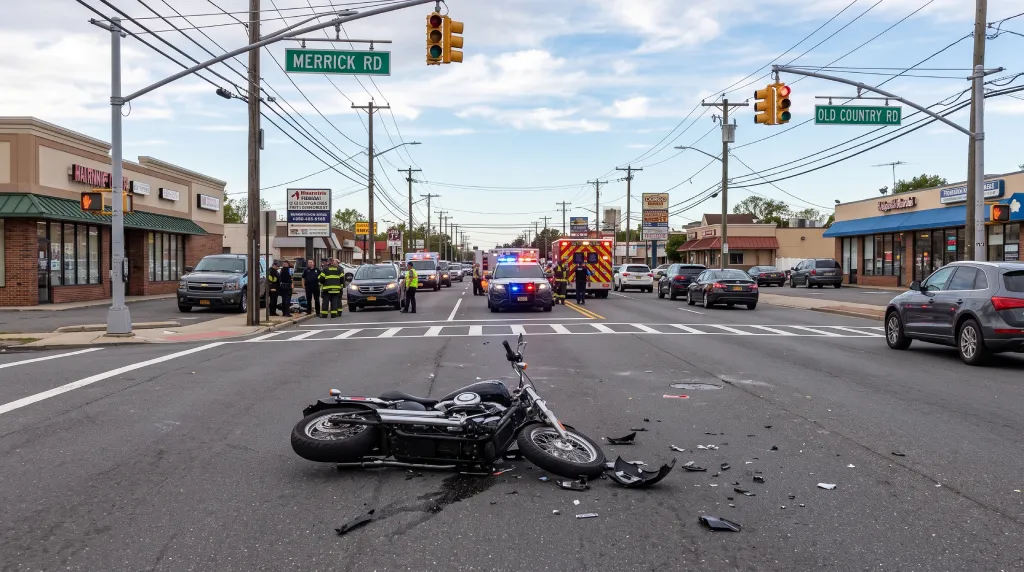
A Nassau County motorcycle accident lawyer at Silver Law Group can look at your crash for free, at any hour, on the phone or at your bedside. Call 212-470-4544 to reach an attorney who speaks English, Spanish, or Russian, and start the case the same day you call. A motorcycle claim in New York does not run on the rules that cover car drivers, and the wrong first move can cost you money you will never get back. If you are reading this from a bed at Nassau University Medical Center or from home in Hempstead, an attorney will come to you. The consultation costs nothing and puts you under no obligation to hire anyone. Bring the crash report and any photos you took, and we will tell you where you stand.
Why Motorcycle Claims Work Differently in New York
Motorcycles are cut out of New York’s no-fault system by Insurance Law 5102(f). That single exclusion changes almost everything about how your case is paid and how it is fought. A car driver hurt in a crash first turns to their own no-fault benefits, which pay medical bills and a portion of lost wages no matter who caused the collision. As a rider, you get none of that. There is no Personal Injury Protection on your policy to catch your hospital bills in the first weeks after a crash.
The flip side works in your favor. Because no-fault does not apply to you, you are not locked behind the serious-injury threshold that stops many car-crash plaintiffs from suing at all. A driver often has to prove a fracture, significant disfigurement, or permanent limitation before a court will hear the case. You can sue the at-fault driver from the first dollar of harm, for the full range of your losses, without clearing that gate first.
That freedom comes with a cost you feel immediately. With no PIP paying your treatment, the bills land on your health insurance, and every unpaid balance rides on the outcome of your claim against the driver who hit you. This is why the early handling of a Nassau motorcycle case matters so much. The money that would have been automatic for a car driver has to be won from the other side, and the record you build in the first month is what you build the recovery on.
Where Nassau Motorcycle Crashes Happen and Why
Certain Nassau roads put riders in front of the same dangers again and again. The stretch of the Southern State Parkway between roughly Exits 17 and 32 has earned the name “Blood Alley” for a reason, with tight curves, short merges, and heavy speed where a rider has no room to recover from another driver’s mistake. Sunrise Highway and Route 27 carry the same high-speed volume across the county’s south side. The Long Island Expressway, I-495, funnels commuter traffic where lane changes turn deadly for anyone on two wheels.
Surface roads produce their own pattern. Hempstead Turnpike and Jericho Turnpike run long commercial corridors thick with driveways, signals, and turning cars, and that is where the most common motorcycle crash unfolds.
Three causes account for a large share of these collisions:
- Left-turn crashes. A driver turning left across your lane fails to judge your speed or simply does not register a single headlight, and turns directly into your path.
- Lane-change and merge crashes. A driver drifts into your lane on the parkway or expressway because they never checked the blind spot a motorcycle disappears into.
- Dooring. A parked driver opens a door into the travel lane on a busy turnpike, leaving you no time and nowhere to go.
None of these require the rider to do anything wrong. In most of them, the other driver never saw the motorcycle until the impact, which is exactly the fact your case has to establish.
Motorcycle Injuries and Where Nassau Riders Are Treated
A rider has no steel cage, so the body absorbs the crash. The injuries that follow tend to be severe and long to heal:
- Road rash deep enough to need skin grafting and to scar permanently
- Tibia and fibula fractures, often requiring surgery, plates, and months off your feet
- Traumatic brain injury, even in a helmeted rider
- Spinal cord injury that can bring lasting weakness or paralysis
Nassau riders in serious condition are frequently taken to Nassau University Medical Center in East Meadow, the county’s Level I trauma center, or to North Shore University Hospital in Manhasset. Both handle the orthopedic and neurological trauma that motorcycle crashes cause.
The human toll on Long Island is not abstract. Roughly 23 riders died on Long Island roads in 2025. Behind that number are the survivors carrying hardware in their legs and rehab schedules that stretch past a year, which is the recovery your claim has to account for.
What Your Nassau Motorcycle Case Is Worth
Your case value is built from two kinds of losses, and both belong in the claim.
Economic damages are the costs you can add up:
- Medical bills, from the ambulance and trauma stay through surgery, hospital care, and physical therapy
- Lost wages for the time you cannot work, and lost earning capacity if the injury keeps you from your job long-term
- Repair or replacement of your motorcycle and your gear
Non-economic damages cover the harm that has no invoice: the pain of the injury itself, the disfigurement from road rash and surgical scars, and any permanent disability that changes how you live. For a rider left with a limp, a fused spine, or a brain injury, these often carry more weight than the bills.
One point sets your case apart from a car driver’s. With no PIP behind you, your treatment runs through your own health insurance, and those payments and unpaid balances become part of what the claim has to recover. Every bill your health plan covers may carry a lien the case has to satisfy at the end. Getting the full picture of those costs on paper early is what keeps a settlement offer from falling short of what the crash actually took from you.
Where Your Compensation Comes From
Recovery usually comes from more than one source, and part of the work is finding every layer.
- The at-fault driver’s liability policy. New York requires a minimum of $25,000 per person and $50,000 per accident in bodily injury coverage under VTL 311. On a catastrophic motorcycle injury, that minimum is often nowhere near enough.
- Your own SUM coverage. Supplementary Uninsured/Underinsured Motorists coverage, authorized by Insurance Law 3420(f)(2), lets you claim against your own policy when the at-fault driver’s insurance runs out or barely exists. Many riders carry it without knowing how much they have.
- MVAIC. The Motor Vehicle Accident Indemnification Corporation exists for the case where the driver has no insurance at all, or fled the scene and was never found.
When the driver who hit you carries only the state minimum, the difference between a small payout and a real recovery often lives in the SUM and MVAIC layers most people never think to check.
Anti-Motorcyclist Bias and Shared Fault
Insurers and jurors carry an assumption you have to overcome: that the rider was speeding, weaving, or asking for it. An adjuster will read a motorcycle crash as the rider’s fault before reading the file, and a jury may arrive at the courthouse with the same picture in their heads. Part of building your case is dismantling that bias with the physical evidence of what the driver did.
The helmet defense is the most common form this takes. New York’s VTL 381 requires riders to wear a helmet, and a defense lawyer will use that statute to argue that any head injury was made worse by how you were riding, trying to shrink the damages for a brain injury even when the other driver caused the crash.
Shared fault has real teeth here. Under CPLR 1411, New York uses pure comparative negligence, so any percentage of fault a jury assigns to you comes straight out of your recovery. If your damages are found to be $100,000 and you are held 20 percent at fault, you collect $80,000. That is exactly why the insurer pushes so hard to pin some share of blame on the rider, and why the fault fight is often the whole case.
What to Do After a Nassau Motorcycle Crash
What you do in the first hours shapes what the claim can prove later. If you are able:
- Photograph everything at the scene — the vehicles, the road, skid marks, your injuries, and the other driver’s plate and insurance card.
- File the DMV crash report. New York requires an MV-104 within 10 days when injury or significant property damage is involved.
- Get the names and numbers of every witness before they leave. The driver who turned into you will remember it differently by next week.
- See a doctor the same day, even if you feel able to walk away. Brain and internal injuries can stay quiet for a day or two, and a gap in treatment is the first thing an insurer uses against you.
- Say nothing recorded to the other driver’s insurer. Their adjuster may call within days asking for a “quick statement,” and that recording exists to reduce what they pay you.
If the crash left you unable to do any of this, an attorney can gather the scene evidence, the police record, and the witnesses on your behalf.
How Long You Have to File
Your case runs on more than one clock, and the shortest one that applies is the one that can end it.
The main deadline for an injury claim is three years from the date of the crash under CPLR 214. Miss it, and the court will not hear the case no matter how strong it is.
If a rider died, the claim changes shape. A wrongful-death action under EPTL 5-4.1 must be brought within two years of the death, a full year shorter than the injury deadline, and it belongs to the estate rather than to the injured rider.
A government vehicle shortens everything. If a city, county, or state vehicle was involved, GML 50-e requires a Notice of Claim within 90 days of the crash, long before the three-year window would otherwise matter. That single form, filed late, can close the case before it starts.
One deadline you can ignore is the 30-day no-fault filing rule that car drivers race to meet. Because Insurance Law 5102(f) leaves riders out of no-fault, that 30-day window does not apply to you. The trade-off is the one already described: no PIP benefits to file for in the first place.
Why Choose Silver Law Group
You pay nothing up front and nothing out of pocket. Silver Law Group handles motorcycle cases on a contingency fee, which means the firm’s fee is a percentage of what it recovers for you and is paid only if it recovers. If the case brings in nothing, you owe no attorney’s fee. That structure lets an injured rider hire a lawyer while the bills are stacking up and the paycheck has stopped.
Every case is prepared as if it will be tried. Insurers settle motorcycle claims for their real value when they see a file built for a Nassau County jury, and the firm files in Nassau County Supreme Court in Mineola when a fair settlement does not come. Preparing to try the case is what gives a settlement demand its weight.
The office is at 49 West 37th Street in Midtown Manhattan, but you do not have to travel to it. If you are laid up at North Shore University Hospital or recovering at home anywhere in Nassau, an attorney will come to you to start the case.
Call 212-470-4544 for a free consultation, any time of day or night, in English, Spanish, or Russian. The call costs nothing, and it is where your case begins.