

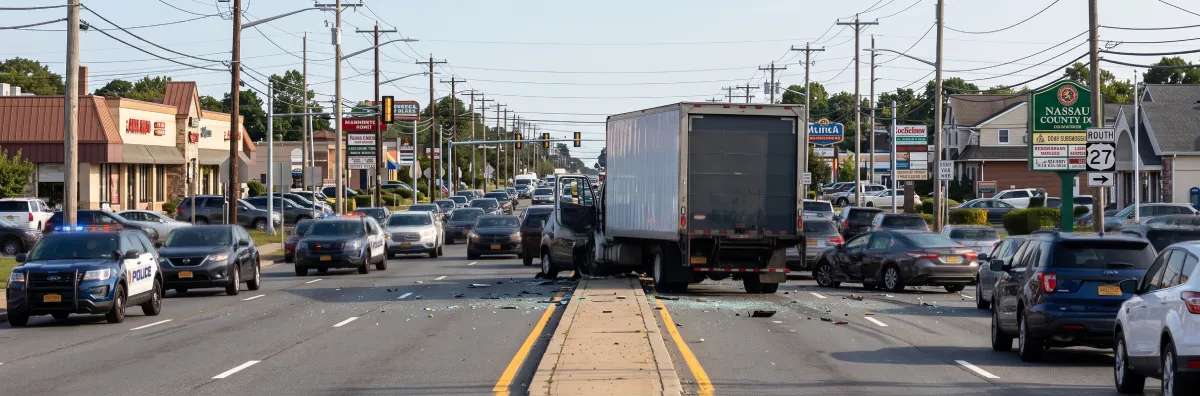
A tractor-trailer crash on the Long Island Expressway can leave you with fractures, surgery, and months off work while the carrier’s insurer is already building a file against you. A Nassau County truck accident lawyer at Silver Law Group represents injured victims and drivers against commercial trucking companies and the insurers that defend them, treating your case as what it is: a claim governed by federal trucking rules, not ordinary car-accident law. The firm moves fast to lock down evidence a carrier can erase — driver logs, black-box data, dashcam footage. Every case starts with a free review of what happened and what the claim is worth. Call 212-470-4544, day or night.
Do You Have a Truck Accident Case in Nassau County
New York’s no-fault insurance pays your early medical bills and lost wages after a crash no matter who caused it, but it also bars you from suing the truck driver for pain and suffering. The exception is the serious-injury threshold in Insurance Law 5102(d). Cross it, and you can pursue the full value of your claim against the trucking company; fall short, and no-fault is all you get.
The statute lists the injuries that qualify. A bone fracture counts on its own. So does significant disfigurement — the scarring that follows road rash, burns, or the surgery to repair a shattered limb. So does a permanent limitation of a body organ, member, or function: the shoulder that no longer rotates, the spine that keeps you from lifting your child. Truck crashes produce these injuries at a rate car crashes rarely match, because a loaded tractor-trailer weighs many times what a passenger car does.
The type of truck matters to how the case is built. A tractor-trailer or 18-wheeler jackknifing across the Long Island Expressway falls under federal carrier rules. A semi-truck hauling freight, a box truck making regional deliveries, and a local delivery van each carry different insurance and different records. A lawyer for a truck accident reads those differences early, because they decide who you can hold responsible and how much coverage stands behind your claim.
Who Can Be Held Liable for Your Nassau Truck Crash
A car crash usually has one target: the other driver. A truck crash almost always has several, and the money to pay your claim is spread across them.
- The driver, if fatigue, speeding, or a phone put the truck into you.
- The motor carrier that employed the driver, for negligent hiring, poor maintenance, or schedules that push drivers past their limits.
- The company that loaded the cargo, when a shifting or overweight load sent the truck into a jackknife or rollover.
- The freight broker that arranged the haul, if it hired a carrier it knew or should have known was unsafe.
- The manufacturer of a defective brake, tire, or coupling that failed under normal use.
Federal law caps how long a trucker can stay behind the wheel. The FMCSA’s hours-of-service rules set hard limits on driving time and force mandatory rest, and a driver who pushed past them, along with the carrier that ignored it, both answer for the crash.
Proof of that violation lives in machines that overwrite themselves. The truck’s electronic logging device records hours and speed; its black box, or engine control module, captures braking and throttle in the seconds before impact. Carriers are only required to keep some of this data for a limited period, and a truck back in service can lose it. This is why a Nassau truck accident lawyer sends a spoliation letter within days — a formal demand that the carrier preserve the ELD, the black box, and the driver’s logs before they vanish.
When a Government or Municipal Truck Is Involved
Everything changes when the truck belongs to a public agency. A Nassau County highway or sanitation truck, an LIRR maintenance vehicle, or an MTA truck is protected by a short clock most people miss. Under General Municipal Law 50-e, you have to file a formal Notice of Claim within 90 days of the crash — not a lawsuit, but a separate written notice telling the agency you intend to sue. Miss it, and your right to sue can be gone before you knew the deadline existed. The suit itself then has to be filed within one year and 90 days, far shorter than the window for a crash with a private carrier. Because both clocks run from the date of the crash, a truck accident lawyer needs the file early enough to serve the notice on time.
What Your Nassau Truck Accident Claim Is Worth
Your claim has two halves, and the trucking company’s insurer will try to shrink both.
Economic damages are the costs you can put a receipt to: the ambulance and ER bill, the surgery, the physical therapy, the wages you lost while you couldn’t work. They also reach forward. If a spinal injury means more operations in ten years, that future medical cost belongs in the claim now, valued by doctors and economists rather than guessed at. If you can never return to the job you trained for, lost earning capacity measures the gap between what you would have earned and what you can earn now, across your whole working life.
Non-economic damages cover what has no invoice — the pain, the sleeplessness, the hobby you gave up, the strain a permanent injury puts on your family. These are often the larger part of a serious truck-crash claim, and they are exactly what no-fault blocks until your injury clears the 5102(d) threshold.
Then there is the insurer’s favorite argument: that the crash was partly your fault. New York follows pure comparative negligence under CPLR 1411. If a jury decides you were 20 percent responsible — say you were speeding when the truck turned across your lane — your recovery drops by 20 percent, but it is not erased. Even a driver found mostly at fault can still recover the share that belongs to the truck. That rule is why carriers work so hard to pin blame on you early, and why what you tell an adjuster in the first week carries so much weight.
Where Truck Accidents Happen in Nassau County
Trucks in Nassau County are not spread evenly across the map. A law most drivers never think about pushes them onto a handful of roads.
Nassau’s parkways ban commercial trucks under Vehicle and Traffic Law 1621, which lets the state keep tractor-trailers off parkway lanes built for passenger cars and lined with low overpasses. Every semi and box truck crossing the county is funneled onto the roads that do allow them, and that is where the crashes cluster.
The Long Island Expressway, I-495, carries the heaviest truck traffic in the county across Exits 33 through 48, where merging freight, sudden slowdowns, and a wall of tractor-trailers in the right lanes turn a routine commute into a pileup risk. Sunrise Highway, NY-27, runs the south shore with a mix of local delivery trucks and through freight, its traffic signals and shopping-center curb cuts creating the stop-and-go conditions where a loaded truck can’t brake in time. Jericho Turnpike, NY-25, threads through the county’s older commercial strips, narrow and lined with driveways, so a box truck making deliveries shares tight lanes with turning cars. Hempstead Turnpike carries dense local traffic past stores, hospitals, and busy intersections, one of the harder corridors on Long Island for the pedestrians and drivers who share it with trucks.
Where your crash happened shapes the case. The road, the exit, the traffic pattern, and the surveillance or business cameras nearby all feed the reconstruction, and a truck accident lawyer who knows these corridors knows where that footage lives.
What to Do After a Truck Accident in Nassau County
What you do in the first hours after a truck crash can decide the case. A few steps matter more than the rest.
- Photograph everything you safely can: the truck’s plates and USDOT number, the position of the vehicles, skid marks, your injuries, and any damage, before the truck is towed and the scene is cleared. If your car or a nearby vehicle has a dashcam, save that footage, because it can overwrite itself within days.
- Get medical care the same day. Go to a trauma center — North Shore University Hospital in Manhasset or Nassau University Medical Center in East Meadow both handle serious crash injuries — even if you feel able to wait. Internal injuries and spinal damage often stay quiet for a day or two, and a gap between the crash and your first treatment is the first thing an insurer uses to argue you were not really hurt.
- Say nothing recorded to the carrier’s insurer. A truck company’s adjuster will call fast and friendly, asking for a recorded statement. You are not required to give one, and anything you say can be trimmed and used to cut your claim. Give your name, get the claim number, and send the adjuster to your lawyer.
How Long You Have to File a Nassau Truck Accident Claim
You have three years from the date of a Nassau County truck crash to file a personal-injury lawsuit. That deadline comes from CPLR 214, and once it passes, the court will not hear your case no matter how badly you were hurt or how clearly the truck driver was at fault.
Three years can feel like plenty while you are still in treatment. It is not. Evidence decays long before the deadline: the ELD data overwrites, witnesses move, the truck goes back on the road. The practical window to build a strong case is far shorter than the legal one.
If the crash killed a family member, a different clock runs. Under EPTL 5-4.1, a wrongful-death claim must be brought within two years of the death, and only the estate’s representative can file it. That shorter deadline surprises grieving families who assumed they had the same three years.
A crash involving a government truck runs on the far shorter municipal clock described earlier, so a truck accident lawyer sorts out which deadline governs at the first meeting. Getting it wrong ends the claim.
Truck-injury suits for Nassau crashes are filed at the Nassau County Supreme Court, 100 Supreme Court Drive in Mineola, the courthouse where your case would be heard if it does not settle first.
What Hiring a Nassau Truck Accident Lawyer Costs
Nothing up front, and nothing at all unless the firm wins your case. Silver Law Group takes truck accident claims on a contingency fee, which means the firm’s payment is a percentage of the money it recovers for you, through a settlement or a verdict, and only that. If there is no recovery, you owe no attorney’s fee. You are not billed by the hour, and you do not pay costs out of pocket while the case runs; the firm advances the expenses of building your claim and is repaid from the recovery.
That structure exists so an injured person with medical bills and no paycheck can still afford to take on a national trucking company and its insurers.
The first conversation is free, available 24 hours a day, and handled in English, Spanish, or Russian. If your injuries keep you from traveling, the attorney comes to you — at your home or your hospital room in Nassau County — so getting a case reviewed never depends on whether you can make it to the firm’s Midtown office.
Contact a Nassau County Truck Accident Lawyer
The trucking company started building its defense the day of the crash. You can start building your case just as fast. Silver Law Group prepares every truck claim as if it will go to trial, because carriers and their insurers settle fairly only when they believe the firm is ready to put the case in front of a Nassau County jury.
A free consultation with a Nassau County truck accident lawyer costs you nothing and commits you to nothing. Call 212-470-4544 any hour of the day, or fill out the free case-evaluation form on this page, and a lawyer will review what happened, explain your deadlines, and tell you honestly what your claim looks like.