

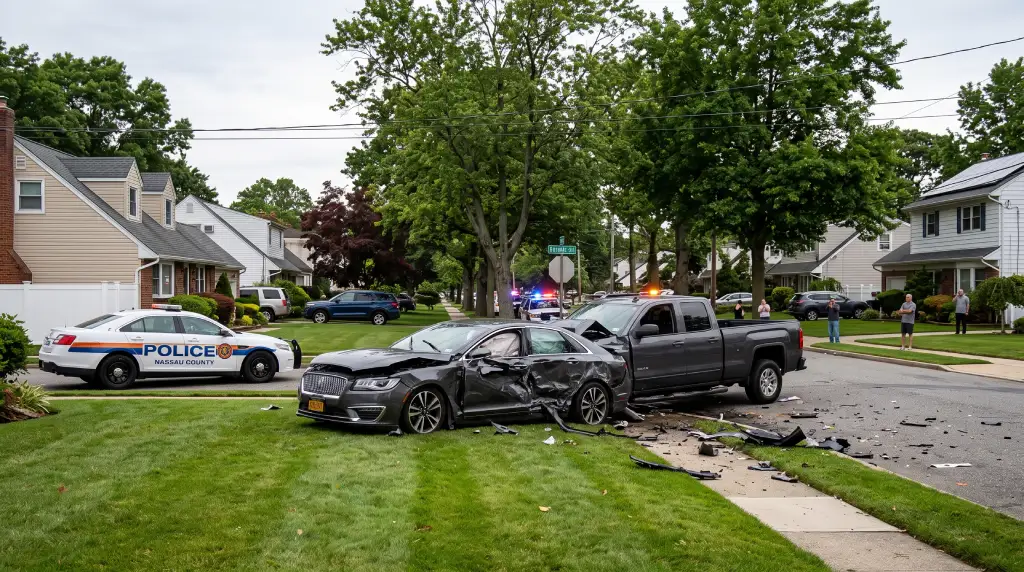
When a Nassau insurer declares your car a total loss, the payout attached to it is a starting figure, not a final one, and it usually sits below what your vehicle is worth. Silver Law Group works as your Nassau total loss attorney, pushing back on the undervaluation carriers rely on after crashes on the Southern State Parkway, the Long Island Expressway, and the local roads through Hempstead and Mineola. We read your policy line by line, price your vehicle against real market sales, and hold the adjuster to the numbers New York regulation actually requires. Every case begins with a free consultation in English, Spanish, or Russian, and if you were injured, the attorney can come to your home or hospital room. Call 212-470-4544 before you sign a release or accept a check.
When New York Insurers Declare Your Nassau Vehicle a Total Loss
New York ties the total-loss decision to a single ratio. Under 11 NYCRR 216.7, an insurer may treat your vehicle as a total loss once the cost to repair it, added to its salvage value, reaches 75% of the car’s actual cash value. Below that line, the carrier owes you a repair. At or above it, the company can declare the car a total loss and pay you its value instead of fixing it.
That 75% threshold takes the choice out of your hands. A late-model car with heavy front-end damage from a rear-end chain on the Long Island Expressway can cross the line on frame and airbag costs alone, even when the car still drives. Older vehicles hit the threshold faster, because a lower actual cash value means a smaller repair bill tips the ratio.
High-speed impacts on the Southern State Parkway and the merge points feeding the LIE produce exactly the kind of structural and mechanical damage that pushes a claim past 75%. Airbag deployment, a bent unibody, a cracked engine block, or flood damage after a storm all stack repair costs quickly.
The figure that drives everything is the actual cash value, because 75% of a low ACV is a low repair ceiling. Set your car’s value too low, and the insurer can total a car that should have been repaired, or hand you a total-loss check that falls short of a replacement. A Nassau total loss lawyer starts by testing that value, since the same number decides both whether your car is totaled and what the company owes you for it.
How Actual Cash Value Is Calculated Under New York Law
Actual cash value is not the price you paid or the balance on your loan. Under 11 NYCRR 216.6(b), an insurer must settle a total loss at the lesser of two figures: the cost to repair the vehicle, or the cost to replace it with a substantially identical vehicle. On a total loss, that means replacement cost — what it takes to buy the same year, make, model, trim, mileage, and condition on the Nassau market.
New York’s Regulation 64 controls how the carrier reaches that replacement number. The insurer cannot pull one low figure from a single source. It must base the offer on the retail values from at least two approved pricing manuals and average them, or use the actual retail cost of a comparable vehicle available to you.
The settlement also has to include the taxes and fees you would pay to replace the car:
- Sales tax on the replacement vehicle’s value
- Title and registration fees
- Dealer-imposed charges New York recognizes as part of replacement cost
Carriers routinely leave sales tax out of the first offer, then reimburse it only if you ask, so the opening number can be short by hundreds before anyone discusses condition.
Condition and options are where valuations drift low. A clean service history, low mileage, a recent set of tires, or a higher trim package all raise your car’s actual cash value, and adjusters often price a base model when yours was loaded. Every one of those adjustments is negotiable, and each moves both the ACV and the 75% total-loss line that depends on it.
Disputing a Lowball Total Loss Offer
A low total-loss offer is a negotiating position, and New York gives you specific ways to move it. The dispute runs as an escalation, not a single phone call:
- Build the comparables. Pull retail listings for the same year, make, model, trim, and mileage from Nassau and nearby Long Island dealers, and document your car’s real condition and equipment. Sales the adjuster left out are the fastest way to raise the number.
- Get an independent appraisal. A licensed appraiser inspects the vehicle, prices it against the local market, and produces a figure you can put in front of the adjuster when your own records are not enough.
- Invoke the appraisal clause. Almost every New York auto policy lets either side demand appraisal when you disagree on value. You name an appraiser, the company names one, and a neutral umpire breaks a tie. That process takes the number out of the adjuster’s hands.
- File a DFS complaint. Insurance Law 2601 bars unfair claim settlement practices, including offers unreasonably low against actual value, refusing to explain how a figure was reached, and forcing you to sue for what the policy owes. A complaint to the Department of Financial Services puts the carrier’s file under regulatory review.
A Nassau total loss lawyer runs these steps in order and in writing. We assemble the comparables, commission the appraisal when the file needs it, demand appraisal under the policy, and raise Insurance Law 2601 when the adjuster’s tactics warrant it. Every offer and demand goes on paper, so if the dispute reaches court, the record already shows what the insurer should have paid and when.
Recovering Diminished Value After Repairs
Even a well-repaired car is worth less once it has a wreck on its record, and that lost value has a name: diminished value. A buyer pays less for a vehicle with a reported accident, and New York lets you recover that gap in the right circumstances.
The catch is whose insurer owes it. Diminished value is generally recoverable from the at-fault driver’s liability insurer as part of your property-damage claim, because that carrier is responsible for the full harm its insured caused, including the resale hit. Against your own insurer, first-party diminished value is usually barred, so a claim you file on your own collision coverage typically will not pay it.
That makes the at-fault carrier the target when another driver caused your crash on a road like Hempstead Turnpike or Old Country Road. To value the loss, insurers lean on a shorthand called the 17c formula, which caps diminished value using a fixed percentage and mechanical mileage and damage deductions. The 17c number is almost always low, and it is not the law in New York.
You are not bound by the insurer’s formula. An independent appraisal that measures your specific car’s market loss, based on real comparable sales with and without accident history, routinely produces a higher and better-supported figure than 17c. Challenge the formula with that appraisal, and the diminished-value number moves the same way a lowball total-loss offer does.
What Your Total Loss Claim Should Include
A total-loss payout is more than the check for your car’s value. Depending on your coverage and your loan, several other pieces belong in the settlement, and carriers do not always volunteer them.
- Gap coverage. When you owe more on the car than it is worth, actual cash value alone leaves you paying a loan on a vehicle you no longer have. Insurance Law 3427 governs gap insurance in New York, and if you bought it, gap coverage pays the difference between the ACV settlement and your remaining loan balance. Check your finance paperwork, because gap is often bundled into the loan without the driver remembering it.
- Rental reimbursement. If your policy includes rental coverage, the insurer owes you a rental car while the claim is open, not just for a few days. You are entitled to reasonable transportation until the carrier makes a proper settlement offer, so a slow-walked valuation should not leave you stranded and paying out of pocket.
- Lienholder priority. When a bank or credit union holds the title, the total-loss check is usually written jointly to you and the lienholder, and the loan gets paid first. Any equity above the payoff is yours.
The order matters. The lienholder is paid from the ACV settlement before you see a dollar, gap coverage fills the hole if the loan is underwater, and rental coverage keeps you moving while all of it gets sorted. A Nassau total loss attorney checks each of these against your declarations page, because a settlement that pays fair value on the car but ignores gap, rental, or a registration refund still leaves money on the table.
Steps to Take After Your Car Is Totaled in Nassau
What you do in the first weeks protects both your money and your record.
- Photograph the car before it leaves your hands. Damage, mileage, tires, and interior condition all support a higher actual cash value, and once the car is gone you cannot re-shoot it.
- Decide whether to surrender the wreck or keep it. If you let the insurer take it, the company handles the salvage title. If you keep it, New York issues a salvage certificate, and the car can only return to the road as REBUILT SALVAGE after passing a DMV salvage inspection, which permanently lowers its value.
- Return your plates to the DMV once the car is off the road. Surrendering plates stops your registration and lets you reclaim a refund for the unused term.
- Refuse a broad release. Adjusters often attach a property-damage release to the total-loss check that also waives claims you have not settled. Read it, and reject language that gives up more than the value of the car.
A short call with a lawyer before you sign is the cheapest insurance you will buy all week.
What It Costs to Work With Us
Cost should never be the reason you accept a lowball total-loss check, so here is exactly how paying us works.
If your crash caused injuries, we handle the injury claim on a contingency fee. You pay no fee up front and no hourly bill. Our fee is a percentage of what we recover for you, and if we recover nothing, you owe no attorney fee. Case costs come out of the recovery, not your pocket along the way. That structure means the firm only gets paid when you do, and it lets an injured Nassau driver hire a lawyer without touching savings during the months a claim takes.
A property-damage-only total-loss dispute works differently, because the dollars in play are smaller. Those cases start with a free consultation, where we read your policy, size up the insurer’s offer against your car’s real value, and give you demand-letter guidance you can act on. You will know what your claim is worth and what the next step costs before you decide anything.
Either way, the first conversation is free. Call 212-470-4544.
Deadlines: Insurer Timeframes and Your Right to Sue
A total-loss claim runs on two sets of clocks: the ones the insurer has to meet, and the one you have to meet. Miss the carrier’s, and the delay itself can support a bad-faith argument:
- 15 business days to acknowledge. Under 11 NYCRR 216.4, the insurer must acknowledge your claim within 15 business days of receiving notice.
- 15 business days to accept or deny. Under 11 NYCRR 216.6, once the company has your proof of claim, it has 15 business days to accept or deny it and to explain the basis for its offer.
- 5 business days to pay. Under 11 NYCRR 216.6(f), after you and the insurer agree on the amount, the carrier has 5 business days to send payment.
Your own deadline is the one that ends the fight for good. Under CPLR 214, you have three years from the date of the crash to file a lawsuit for property damage, including a total-loss or diminished-value claim against the at-fault driver. Three years feels long, but the negotiation, appraisal, and any DFS complaint all run inside it, and the day it passes your right to sue is gone no matter how strong the file.
Track both clocks from the day of the wreck. The insurer’s short deadlines give you leverage while the claim is open, and the three-year limit sets the outer edge a Nassau total loss lawyer works backward from.
Where Nassau Total Loss Disputes Are Decided
If negotiation and appraisal do not resolve your claim, where you file depends on how much is at stake.
For smaller disputes, Nassau County District Court hears small claims at 99 Main Street in Hempstead, with a jurisdictional limit of $5,000. Small claims is built for people without lawyers: filing fees are low, the rules are relaxed, and you can bring your comparables, your appraisal, and your photographs and argue the value yourself in front of a judge or arbitrator. For a modest total-loss gap or a diminished-value claim, it is often the right room.
Larger claims belong in the Supreme Court, Nassau County, in Mineola, which handles cases above the small-claims ceiling. That is where a substantial total-loss dispute, a bad-faith fight with a carrier, or a property-damage claim joined to an injury case gets litigated, with full discovery and the option of a jury.
Choosing the right court matters. File a large dispute in small claims and the $5,000 ceiling caps what you can recover; file a small one in Supreme Court and the cost and delay can swallow the claim. A Nassau total loss attorney picks the forum that fits the money and the facts.
Why Nassau Drivers Choose Silver Law Group
Look at other total-loss and injury pages and most lead with the same thing: a wall of dollar figures and award badges meant to prove they win. We do not put numbers on a billboard, because a past result tells you nothing about what your car is worth or what your claim needs.
Here is what we put in front of you instead. Every case is prepared as if it will be tried, so the insurer negotiates against a file built for a courtroom, not a quick settlement. The phone is answered 24/7, because a crash and an adjuster’s first call do not wait for business hours. If you were hurt, the attorney comes to your home or your hospital room in Nassau rather than making you travel to Midtown. And every consultation happens in English, Spanish, or Russian, so nothing about your claim gets lost in translation.
The office is at 49 West 37th Street, 7th Floor in Manhattan, and the same lawyer who reviews your policy is the one who argues your value.
Before you cash a total-loss check or sign a release, find out what the claim is really worth. Call Silver Law Group at 212-470-4544 for a free consultation.