

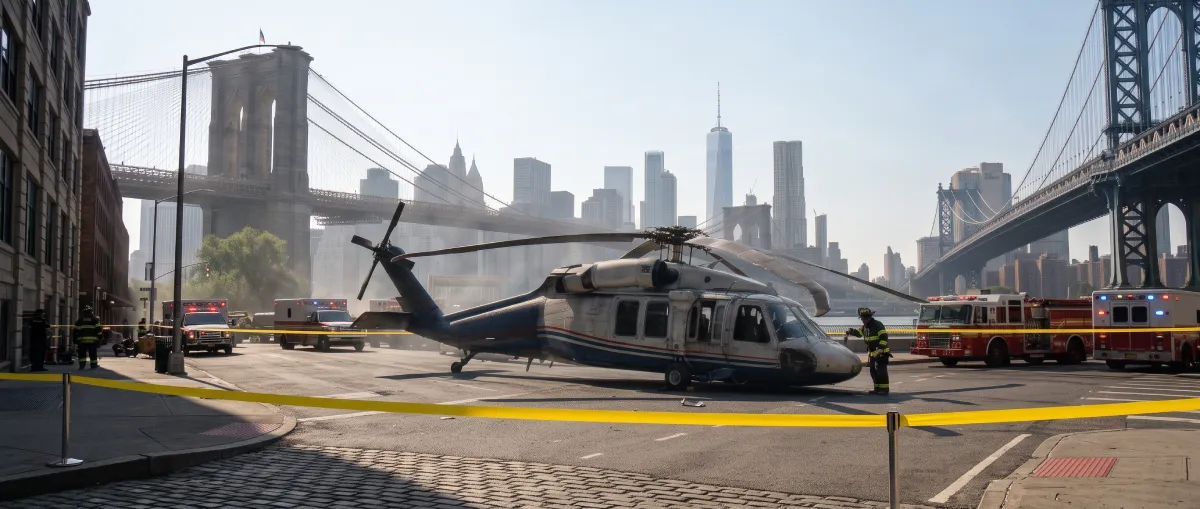
If you were hurt in a plane or helicopter crash, a Brooklyn aviation accident lawyer at Silver Law Group can tell you who is responsible and what your claim is worth. These cases run on federal deadlines and pull in parties most injury firms rarely face: airlines, aircraft manufacturers, maintenance contractors, and government agencies. We handle aviation accident claims for people across Brooklyn on contingency, so you pay nothing unless we recover money for you. The first consultation is free, available 24 hours a day, in English, Spanish, or Russian. If you cannot travel, the attorney comes to your hospital room or your home. Call 212-470-4544.
Do You Have an Aviation Accident Case?
An aviation claim starts with negligence: proof that someone with a duty to keep the aircraft safe failed at it, and that the failure caused your injuries. In most crashes more than one party shares the blame, and identifying all of them is what protects the full value of your case.
Pilot error is the most common cause: flying into weather the aircraft was not rated for, misreading instruments, or ignoring air-traffic instructions. Mechanical and maintenance failure is the next likeliest — a cracked turbine blade, a corroded fuel line, or a repair signed off but never performed. A defective part shifts fault onto the company that designed or built it, even when the pilot and mechanic did everything right. And a controller who cleared two aircraft into the same airspace can put a federal agency on the hook.
Each cause points to a different defendant:
- The airline or charter operator, for the conduct of its crew
- The manufacturer, for a design or production defect in the airframe, engine, or components
- The maintenance contractor, for repairs done wrong or skipped
- A government agency, when an FAA air-traffic controller’s mistake contributed to the crash
The evidence that sorts this out usually comes from the National Transportation Safety Board. The NTSB investigates every civil aviation crash in the country and publishes a probable-cause finding along with the factual record: flight-data and cockpit-voice recorder readouts, maintenance logs, and witness statements. That record is not the last word in a courtroom, but it points to the parties worth pursuing and the theories that will hold up. An aviation accident lawyer builds your claim around it and the parallel evidence a private investigation can preserve before it disappears.
Aviation Accidents We Handle in Brooklyn
The firm takes cases across every category of aircraft that flies over or near Brooklyn.
- Commercial airliners on approach to JFK and LaGuardia, whose flight paths cross the borough at low altitude
- Private and charter planes, where a single operator’s cost-cutting on maintenance or crew training often sits at the root of the crash
- Helicopter tour flights and medevac transports, which carry heightened risk from low-altitude maneuvering and repeated takeoffs and landings
- Seaplanes operating off the waters around the borough, governed by both aviation rules and maritime law
- Drones flown for commercial and news work, which cause injury when they lose control or strike a person
- Airport ground-crew and ramp-worker injuries — the baggage handlers, fuelers, and mechanics hurt by ground-service equipment, jet blast, or a fall on the ramp
Ramp and ground-crew cases deserve a note of their own. If you were hurt working the ground at an airport, your employer’s workers’ compensation is usually not the end of the story. A third party — the airline whose equipment failed, the contractor whose vehicle struck you, or the manufacturer of a defective ground vehicle — can be sued directly, and that claim carries damages workers’ comp never pays, including full lost earnings and pain and suffering. The category of aircraft changes which laws apply and who you sue, so the first job is matching your crash to the right legal track.
Which Laws Govern a Brooklyn Aviation Claim?
Which body of law controls your case depends on where the aircraft was going and who operated it, and that choice often decides how much you can recover.
FAA regulations set the safety standard. They dictate how aircraft are maintained, how pilots are certified, and how airspace is managed, and a violation of an FAA rule is strong evidence of negligence in a New York injury suit. But the FAA rules themselves do not pay your damages; they establish the duty that a defendant broke.
For international flights, the Montreal Convention takes over. It governs injury and death on any flight between two countries that signed it, and it makes the airline strictly liable — no proof of fault required — up to 151,880 Special Drawing Rights, a figure that rose to that level on December 28, 2024. Above that ceiling the airline can still be held liable, but it is allowed to argue it was not negligent. The Convention also imposes its own two-year deadline and limits where you can sue, which is why an international flight needs legal advice early.
Crashes over open water bring in the Death on the High Seas Act. When a fatal crash happens beyond roughly twelve nautical miles from shore, a real possibility for flights leaving Brooklyn out over the Atlantic, this federal statute rather than New York law controls the wrongful death claim, and it restricts recovery to the family’s financial losses.
When the negligent party is a federal employee — most often an FAA air-traffic controller — the Federal Tort Claims Act applies. It requires you to file an administrative claim with the agency before you can sue, and it sets its own two-year clock on that filing.
Everything outside these federal tracks runs on New York negligence law: a domestic private plane or helicopter crash inside the state is a state-court case built on ordinary duty, breach, and causation. Sorting your crash into the right track is the threshold decision an aviation accident lawyer makes, because it sets the deadline, the court, and the ceiling on your recovery.
What Your Aviation Injury Claim Could Be Worth
Your claim’s value is built from two kinds of damages: what the crash cost you in money, and what it cost you in everything money does not measure.
The economic side covers hard numbers. Emergency treatment and surgery, the hospital stay, and every follow-up appointment go in first. So does future care — the reconstructive surgeries, physical therapy, and long-term nursing a serious aviation injury can require for years. Lost earnings count from the day you could not work, and if a permanent disability keeps you from returning to your job or forces you into lower-paid work, the claim reaches the income you will never earn.
Non-economic damages cover the human cost. Pain and suffering, the loss of activities you can no longer do, disfigurement, and the psychological weight of surviving a crash all carry value under New York law. Aviation crashes produce a specific pattern of these injuries. Burns from a post-impact fuel fire, and inhalation trauma from breathing superheated air and smoke, cause damage that surfaces over days and demands care that runs for months, driving both the medical and the human side of a claim upward.
One point about aircraft injuries surprises almost everyone: no-fault does not apply. New York’s no-fault system pays the early medical bills after a car crash, but it covers only motor-vehicle occupants. It never reaches injuries from a plane, helicopter, or any other aircraft. There is no quick insurance payment waiting to cover your first hospital bills, which is exactly why establishing another party’s liability early matters so much. A liability claim is the only source of recovery you have.
Fatal Aviation Accidents and Wrongful Death
When a crash kills someone, two separate claims exist, and New York law splits them in a way families rarely expect.
The wrongful death claim belongs to the family, but New York limits it to pecuniary loss — financial losses only. Under EPTL 5-4.3, the recovery covers the income and services the person would have provided, funeral and burial costs, and the value of parental guidance to surviving children. It does not compensate the family’s grief or the loss of the relationship itself. Lawmakers passed the Grieving Families Act to add emotional loss to these claims, but the governor vetoed it again on December 5, 2025, so the pecuniary-only rule still stands.
The second claim survives the death and belongs to the person who died. Under EPTL 11-3.2, if your relative was conscious after the crash and before death, even for minutes, the estate can bring a survival claim for the pain, fear, and suffering they experienced in that time. In an aviation crash, where those final moments can be prolonged and terrifying, this claim often carries real weight.
Both claims run through a personal representative — the person the Surrogate’s Court appoints to administer the estate, usually a spouse, adult child, or parent. Until that appointment is made, no wrongful death or survival suit can be filed, so opening the estate is one of the first steps after a fatal crash. An aviation accident lawyer handles that appointment alongside the claim so the deadline does not pass while the paperwork waits.
Deadlines to File a Brooklyn Aviation Lawsuit
Every aviation claim runs against a deadline, and missing it usually ends the case no matter how strong the facts are. Several clocks can run at once.
- Three years for injury. Under CPLR 214, you have three years from the date of the crash to sue for personal injuries in a New York negligence case.
- Two years for wrongful death. EPTL 5-4.1 gives the estate two years from the date of death to file, a year shorter than the injury deadline and a trap for families who assume the two run together.
- Two years for a federal claim. If an FAA controller or another federal employee is responsible, the Federal Tort Claims Act requires an administrative claim within two years of the crash, filed with the agency before any lawsuit.
- Ninety days for a city aircraft. If a New York City medevac helicopter or other municipal aircraft is involved, General Municipal Law 50-e requires a formal Notice of Claim within 90 days of the crash. Miss that window and the right to sue the city can vanish before the three-year clock has barely started.
International flights add the Montreal Convention’s own two-year limit on top of these. The shortest deadline that applies to your crash is the one that governs, and for a city aircraft that can be as little as 90 days. The safer move is to have a lawyer identify every clock in the first weeks, while evidence is still fresh and no deadline has been lost. Waiting to see how you heal before calling is the single most common way a valid aviation claim dies.
Where Brooklyn Aviation Cases Are Filed
Where your case is filed follows from which law governs it, and Brooklyn crashes split between two courthouses a few blocks apart.
State negligence claims — a domestic private plane or helicopter crash, or a ground-crew injury — are filed in Kings County Supreme Court at 360 Adams Street in Downtown Brooklyn. This is the trial court for injury cases arising in the borough, and it is where a Brooklyn jury would hear your case.
Federal claims go to the United States District Court for the Eastern District of New York, at 225 Cadman Plaza East. A Montreal Convention case against an international carrier, and a Federal Tort Claims Act case against the FAA, both belong in federal court. So do many claims against out-of-state manufacturers, which can be removed to the federal courthouse even when they start in state court.
The distinction matters because the two systems run on different procedural rules, different jury pools, and different timelines, and the choice is not always the plaintiff’s alone to make. Getting the case into the right court from the start, and keeping it there when the other side tries to move it, is part of what an aviation accident lawyer does before the merits are ever argued.
Aviation Risk Over Brooklyn: History and Flight Paths
Brooklyn has lived under crowded airspace for generations, and its worst aviation disaster is still within living memory. On December 16, 1960, United Flight 826 collided with a TWA airliner over Staten Island and came down in Park Slope, striking the corner of Seventh Avenue and Sterling Place. The crash tore through a stretch of the neighborhood and killed everyone aboard both planes along with people on the ground, and it remains one of the deadliest aviation accidents in the city’s history.
The conditions that made it possible have not gone away. Two of the country’s busiest airports sit at the borough’s edge, and their approach paths run directly over it. Aircraft descending into JFK cross southern and eastern Brooklyn at low altitude, and traffic bound for LaGuardia passes over the northern neighborhoods. Every one of those flights passes over homes and streets at its most vulnerable moment, low and slow with landing gear down.
Helicopter activity adds another layer. Floyd Bennett Field, on Brooklyn’s southern shore, has long served as a base for helicopter operations, and tour, charter, and emergency flights move through the borough’s airspace daily. Low-altitude helicopter flying carries its own risks, and when a rotorcraft goes down over a dense borough, the people below are exposed along with everyone on board. This is the airspace your claim comes out of, and it is why local aviation cases turn up here more often than most people assume.
Contact a Brooklyn Aviation Accident Lawyer
Aviation evidence disappears fast. Wreckage gets moved, maintenance records get revised, and the NTSB and FAA begin an investigation you have no automatic access to. The sooner a lawyer starts preserving the flight data, the maintenance history, and the witness accounts, the more of your case survives.
Silver Law Group takes Brooklyn aviation accident cases on contingency. You pay no attorney’s fee up front and no fee at all unless we recover money for you; the fee is a percentage of that recovery, agreed in writing before we start, and if there is no recovery, you owe us nothing for our time. That structure lets you fight an airline or a manufacturer without spending your own money against theirs.
The first consultation is free and available any hour of the day or night, in English, Spanish, or Russian. If your injuries keep you in a hospital bed or at home, the attorney will come to you. Call 212-470-4544 to talk through what happened and what your claim is worth.