

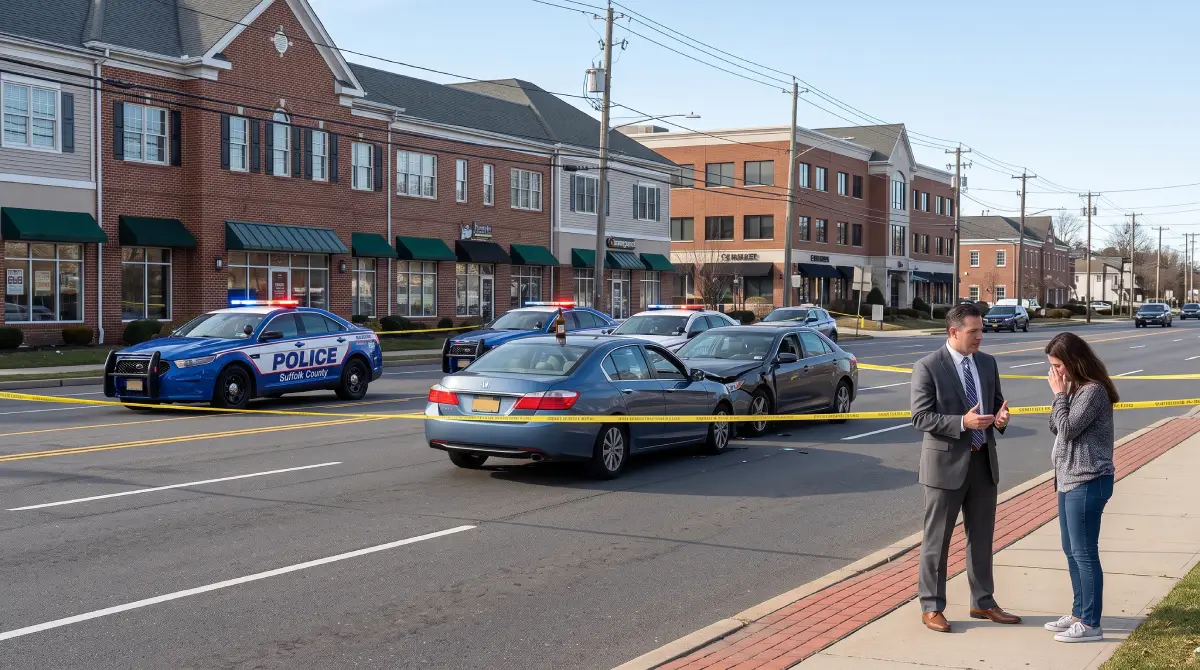
A drunk driver put you in this position, and now you are the one facing the hospital bills, the missed paychecks, and an adjuster who already wants a recorded statement. Silver Law Group represents Suffolk County drivers, passengers, and pedestrians hurt by impaired drivers, and a drunk driver accident attorney from our office can tell you in one free call whether you have a case worth bringing. That consultation costs nothing, it is available any hour of the day or night, and we hold it in English, Spanish, or Russian. You pay us nothing up front and nothing out of pocket. We work on contingency, which means our fee is a percentage of what we recover for you and is owed only if we win; if there is no recovery, you owe us no attorney’s fee. If your injuries keep you from reaching our Midtown Manhattan office, the attorney will come to your home or your hospital room in Suffolk. Your job right now is to heal. Figuring out who pays for this crash is ours.
Drunk Driving Crashes on Suffolk County Roads
Suffolk County records more alcohol-related crashes than any other county in New York. Of the 245 traffic deaths on Long Island in 2022, 164 were in Suffolk, a share that shows how routine impaired driving has become on these roads. The Long Island Expressway carries drunk drivers at highway speed through the middle of the county, and its exits and service roads force the kind of merging and lane changes that turn a slow reaction time into a wreck. Sunrise Highway and Montauk Highway run east toward the forks with long dark stretches where speed climbs and there is nowhere to go when someone drifts over the center line. Route 347 threads through the county’s busiest commercial corridors, where a driver leaving a bar near closing time meets late-night traffic at intersections built for volume, not for a driver who can no longer judge a yellow light.
When a crash happens on one of these roads, the responding agency, whether Suffolk County Police or a village department, documents the scene, and that report is often the first written record of the other driver’s condition. If the driver is arrested, the arrest and any breath-test result become part of the same paper trail your civil claim will later rely on.
Do You Have a Claim Separate From the Criminal DWI Case?
Your injury claim is a separate case from the driver’s DWI prosecution, and it runs on its own track. The district attorney’s case is the state punishing a crime; your case is you asking to be paid for what the crash cost you. Neither one decides the other.
You do not need the driver convicted, or even charged, to win your claim. A criminal conviction requires proof beyond a reasonable doubt, while your injury case only requires proof that the driver was more likely than not at fault. That lower bar is why a drunk driving claim can succeed in civil court even when the criminal side collapses. A suppressed breath test or a dropped charge does not close your case.
Anyone the impaired driver hurt can sue that driver directly. A passenger riding in the drunk driver’s own car can bring a claim against the person who was driving. A pedestrian struck in a crosswalk can bring one. A driver hit head-on can bring one. Each of you has a claim of your own, and one person’s case does not cancel out another’s.
Who Else Can Be Held Liable
The drunk driver is rarely the only party who owes you money. New York’s Dram Shop Act, General Obligations Law 11-101, lets you sue a bar, restaurant, or store that sold alcohol to someone already visibly drunk, or to anyone under 21, when that sale led to your injuries.
This matters for a hard practical reason. The driver who hit you may carry only the state-minimum policy and own nothing worth pursuing, while the business that overserved them carries commercial liquor-liability coverage. Proving a Dram Shop claim means showing the server kept pouring for someone who was slurring or could barely stand, which is why the bar’s receipts, its surveillance video, and the accounts of other patrons can matter as much as the police report.
New York also recognizes social-host liability, though it reaches further only in narrow circumstances. A homeowner who serves alcohol to a guest under 21 who then drives and injures you can be held responsible; serving an already-drunk adult guest generally does not create the same exposure.
An employer can be on the hook when the drunk driver was working at the time, making a delivery, driving between job sites, or heading to a client, because a company answers for what its employees do on the job. A commercial policy standing behind the driver is often the difference between a judgment on paper and a claim that actually gets paid.
What Your Case Is Worth
New York puts no cap on the damages you can recover in a personal-injury case, so the size of your claim tracks your actual losses and the proof behind each one. Those losses fall into categories the law recognizes:
- Medical bills for emergency care, surgery, hospital stays, and the treatment you have already been billed for
- Future care, meaning the surgeries, therapy, and medication your doctors say you will still need, priced out by a treating physician or a life-care planner
- Lost wages for the time the injury kept you off work
- Diminished earning capacity, when the injury means you cannot return to the job you had or cannot work the hours you used to
- Pain and suffering, for the physical pain and the daily limits the injury forces on you
- Punitive damages, which a jury can add in a drunk driving case to punish the driver when the impairment was egregious, such as a very high BAC, a wrong-way collision, or a repeat offender
Punitive damages are what set drunk driving cases apart from ordinary crashes. A driver who chose to get behind the wheel drunk did something a jury is allowed to punish, not only to pay you back for. Building that part of the claim is why the driver’s BAC reading, any prior record, and their conduct after the crash all get pulled into your case.
No-Fault, Serious Injury, and Shared Fault
Three rules decide whether you can sue the drunk driver and how much you keep if you do. New York’s no-fault system pays your first medical bills and lost wages through your own auto policy no matter who caused the crash, but only if you file the no-fault application within 30 days. Miss that window and you can lose benefits you were owed, so the application goes in early, while you are still in treatment.
No-fault also limits when you can sue for pain and suffering. Insurance Law 5102(d) sets a serious-injury threshold: you can step outside no-fault and sue only if your injury fits a defined category, such as a fracture, a significant limitation of a body function, a permanent consequential limitation, or a disability that keeps you from your usual activities for 90 of the 180 days after the crash. A drunk driving collision at highway speed on the LIE often produces exactly these injuries, yet the defense will still fight whether yours qualifies, which is what makes the medical record you build in the first weeks decisive.
Shared fault does not end your case. Under CPLR 1411, New York follows pure comparative negligence, so if a jury finds you 20 percent at fault, say you were speeding when the drunk driver ran a light, your recovery is reduced by that 20 percent rather than wiped out. Even a driver found mostly at fault can still recover something, which is why the insurer will push hard to pin a share of the blame on you.
What to Do After the Crash
What you do in the first hours after a drunk driving crash shapes the claim you can bring months later. A few steps carry more weight than the rest.
- Call 911 from the scene. A police response means an officer documents the other driver’s condition, and if that driver is impaired, the report and any arrest become the backbone of your civil case.
- Get checked for trauma, not just visible cuts. Stony Brook University Hospital is the only Level 1 trauma center in Suffolk County, so the most serious injuries from a high-speed crash are treated there. Internal bleeding and head injuries do not always show at the scene, and a same-day exam creates the record that ties your injuries to the crash.
- Save the proof before it disappears. The police accident report, the driver’s BAC results, dashcam footage from your car or a nearby vehicle, and the names and phone numbers of anyone who saw the crash all fade or get overwritten quickly.
One more step, and it is the one people skip: do not give the other driver’s insurer a recorded statement, and do not cash a quick check, before you know how badly you are hurt. The adjuster often calls within days, sometimes before you are out of pain, and an early recorded answer gets used later to argue your injury was minor.
Deadlines to File Your Suffolk Claim
Three years. That is how long CPLR 214 gives you to file a personal-injury lawsuit over a Suffolk County drunk driving crash, counted from the date it happened. File after that and the court will not hear the case, however clear the driver’s fault.
If the crash killed a family member, the clock is shorter. EPTL 5-4.1 gives the estate two years from the date of death to bring a wrongful death claim. The two deadlines can run at the same time when a badly injured victim later dies, and because they count from different dates, the gap between them decides real cases.
A much shorter deadline applies when a government vehicle was involved, such as a Suffolk County bus, a police cruiser, or a town truck. General Municipal Law 50-e requires a formal Notice of Claim within 90 days of the crash before you can sue a public entity at all. Ninety days passes fast while you are in treatment, so any case that might involve a public vehicle gets reviewed right away. Even when the three-year deadline sits far off, the evidence does not wait for it. Video gets erased, witnesses move, and a bar discards its records on its own schedule, so the practical deadline to start investigating comes long before the legal one to file.
Why Suffolk Victims Choose Silver Law Group
A drunk driving case that does not settle fairly ends up in front of a jury at Suffolk County Supreme Court in Riverhead, and the firm you hire should be ready to try it there rather than pressured into the first offer because it never prepares for trial. We prepare every case as if it is headed to Riverhead, which is what gives an insurer a reason to pay fairly before it gets that far.
If your injuries keep you home or in the hospital, the attorney comes to you anywhere in Suffolk, from Riverhead to Huntington to Islip to the East End, instead of asking you to travel to Manhattan while you are hurt.
That local footing is the difference between a drunk driving injury lawyer who knows Suffolk’s courts and roads and an out-of-state operation that drops a county name into a template and files every case the same way. Your crash happened on a specific road, in a specific county, and it will be tried under the rules of a specific court.
Start with a free consultation. It costs nothing, it is open 24 hours a day in English, Spanish, and Russian, and you pay no attorney’s fee unless we win. Call 212-470-4544.