

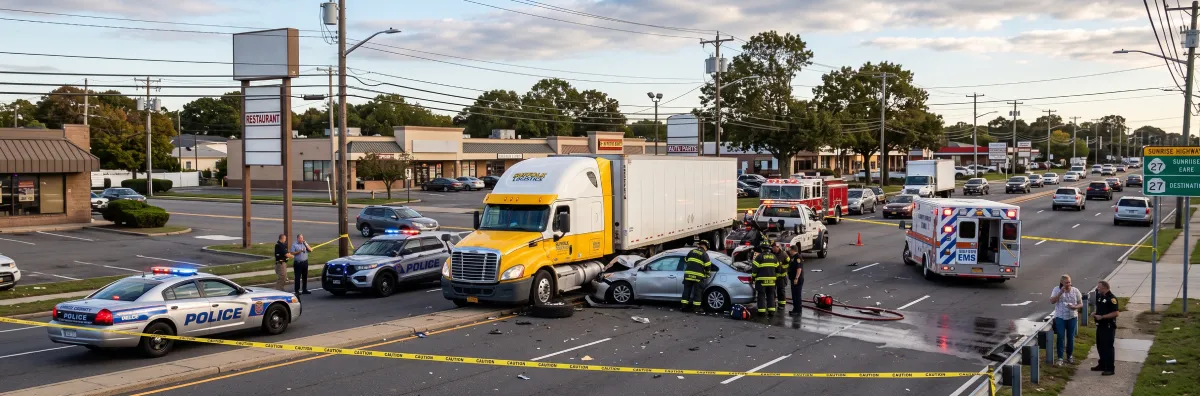
If a tractor-trailer or box truck hurt you on a Suffolk County road, a Suffolk County truck accident lawyer at Silver Law Group can tell you within one free call whether you have a case. Call 212-470-4544 for a free case review, available 24 hours a day, seven days a week. We handle commercial-truck crashes across Long Island, from the Long Island Expressway pileups to the Route 110 wrecks where an 80,000-pound rig hits a passenger car and the driver walks away while you go to the hospital. A truck case is not an ordinary car accident. The carrier’s insurer starts building its defense the day of the crash, and the sooner a lawyer preserves the evidence, the harder that defense is to run.
Do You Have a Suffolk County Truck Accident Case
New York is a no-fault state, so your own auto insurance pays your first medical bills and lost wages no matter who caused the crash. But no-fault will not let you sue the trucking company for your pain, your permanent injury, or the losses it refuses to cover. To reach the carrier, your injury has to clear the serious injury threshold written into Insurance Law 5102(d).
That threshold includes:
- A bone fracture, of any size
- Permanent loss of use of a body organ, member, or system
- Permanent consequential limitation of a body organ or member
- Significant limitation of use of a body function or system
- Significant disfigurement, including deep scarring and burns
- Death
One category is gone. For any lawsuit commenced on or after May 26, 2026, the 90/180-day threshold, the rule that let you sue when an injury kept you from your usual activities for 90 of the 180 days after the crash, no longer counts. If your claim once rested on that category alone, it now has to fit one of the others.
Truck crashes tend to clear the threshold more readily than car crashes, because the forces involved break bones and cause the kind of permanent damage the statute describes. The threshold is the line between a claim your own insurer closes in a few weeks and a claim worth bringing against the carrier. A lawyer reads your medical records against 5102(d) before the insurer does.
Who Is Liable for Your Suffolk County Truck Crash
A car crash usually has one defendant: the other driver. A Suffolk truck crash usually has several, and finding all of them is where most of your recovery lives. Federal and state law spread responsibility across every company that touched the truck.
- The driver, when fatigue, speed, or a skipped inspection caused the crash
- The motor carrier that employed the driver and controlled the schedule
- The owner of the trailer, often a separate company from the tractor
- The company that loaded the cargo, when a shifting or overweight load played a part
- The maintenance contractor responsible for brakes, tires, and inspections
- The freight broker that arranged the haul and picked the carrier
Each of those companies carries its own commercial policy, and a for-hire interstate carrier must insure a large truck for at least $750,000 in liability under FMCSA rules in 49 CFR Part 387. That layering is why truck cases reach coverage a car case never could, and why the carrier’s lawyers work to keep other defendants off the caption. The same logic reaches smaller vehicles. A Suffolk delivery van or box truck run by a regional grocer, a parcel company, or a contractor carries commercial coverage and an employer answerable for the driver’s conduct on the clock, even though it looks nothing like an 18-wheeler.
Naming the right defendants early matters because each one holds evidence the others do not. The carrier keeps the driver logs, the maintenance contractor keeps the repair records, the broker keeps the load agreement. Miss a defendant and you lose both their policy and their proof.
Suffolk’s Truck Corridors and Restricted Parkways
Suffolk’s freight moves on a handful of routes, and the crash you were in probably happened on one of them. The Long Island Expressway, I-495, carries the county’s heaviest truck traffic and its worst chain-reaction wrecks, where a rig that cannot stop in time slams into stopped cars near an exit. Sunrise Highway, NY-27, runs commercial traffic along the South Shore toward the East End. Route 25 and Route 25A carry local delivery trucks through town centers, and Route 110 funnels commercial vehicles through the Melville and Huntington Station business corridor, one of the densest truck-and-commuter mixes in the county.
What sets Long Island apart is its parkway system. Suffolk’s parkways were built for passenger cars, with low stone bridges and tight curves, and commercial trucks are banned from them by law. A truck on a parkway is rarely a driver who took a wrong turn. It is usually a routing failure the carrier is responsible for.
When a Truck Travels a Banned Parkway
When a truck ends up on the Sagtikos, the Sunken Meadow, or Ocean Parkway, the crash almost always traces back to a decision made before the driver ever left the yard. Trucks are prohibited on these roads because the bridges sit too low and the lanes run too narrow for a tractor-trailer. A box truck or rig that shears its roof on a low overpass along the Southern State Parkway, a recurring event on Long Island, is the plainest version of this: the truck was somewhere it was never allowed to be.
That fact reshapes the case. A carrier is supposed to plan a legal route and program truck-safe navigation, so putting a commercial vehicle on a banned parkway is negligence you can trace to the company, not just to the driver behind the wheel. A GPS meant for cars is no defense; a professional carrier is expected to know the road is closed to trucks. When the vehicle should not have been on that road at all, the trucking company has a much harder time arguing your case down.
What Your Suffolk Truck Accident Claim Is Worth
No lawyer can promise a number, and any Suffolk truck accident lawyer who quotes one before reading your medical file is guessing. What a claim is worth turns on your injuries and how well they can be proven. These are the categories New York law lets you recover:
- Medical bills already incurred, from the emergency room through surgery and rehab
- Future medical care, priced by a life-care planner when the injury is permanent
- Lost wages, plus lost earning capacity when you cannot go back to the same work
- Pain and suffering, the largest part of a serious truck case and the one no-fault never pays
- Wrongful death damages, when a family loses a relative in the crash
One rule changed how fault affects that number. New York long followed pure comparative fault, where your own share of blame reduced your recovery but never erased it. For motor-vehicle actions filed on or after May 26, 2026, CPLR 1411(b) replaces that with a modified-fault bar: once your share of responsibility crosses the statutory line, you recover nothing. In a truck case the carrier will try to load blame onto you, that you braked short, that you sat in a blind spot, precisely to push you past that line.
That turns the fight over fault into a fight over your whole recovery, not just a slice of it. Reconstructing the crash and pulling the truck’s own data early is how a lawyer keeps your share below the bar.
Steps to Take After a Truck Crash in Suffolk County
What you do in the first days after a truck crash decides what your case can prove later. Take these in order.
- Get treated, even if you feel able to wait it out. Suffolk’s Level I trauma care is at Stony Brook University Hospital, 100 Nicolls Road, and Peconic Bay Medical Center in Riverhead serves the East End. The record you create now is what ties your injury to the crash.
- Photograph the DOT number painted on the cab door, along with the trailer, the plates, and the scene. That number identifies the carrier before it can hide behind an insurer.
- Get the names and phone numbers of witnesses before they leave.
- Say nothing to the trucking company’s insurer, and give no recorded statement.
- Call a lawyer fast, because the evidence that wins truck cases is electronic and short-lived.
That last step is the one that costs people their cases. A large truck records its own operation. Electronic logging devices track the driver’s hours behind the wheel, and the carrier’s systems hold the FMCSA hours-of-service records that show whether the driver was even legally allowed to be driving. Federal rules require some of this data to be kept for only six months, and routine overwriting can erase it sooner. A lawyer sends a spoliation letter that legally freezes the logs, the black-box data, and any dashcam footage before the carrier’s ordinary retention cycle wipes them.
Deadlines to File a Suffolk County Truck Claim
Your case runs on more than one clock, and the shortest one you miss is the one that ends it.
- 30 days to file your no-fault application with your own insurer. Miss it and you lose the coverage that pays your first medical bills.
- 3 years from the crash to sue for your injuries, under CPLR 214.
- 2 years from the date of death to bring a wrongful death claim, under EPTL 5-4.1.
- 90 days to file a Notice of Claim under GML 50-e when a government-owned truck hit you, before you can sue that agency at all.
The 90-day government deadline is the trap. If a Suffolk County or Town of Islip truck, a highway department vehicle, or a school district truck caused your crash, the ordinary three-year clock does not save you. Without the Notice of Claim filed on time, the case is over before it starts. A lawyer identifies a public defendant in the first days precisely because that window closes so fast.
Where Your Suffolk Truck Case Is Filed
A Suffolk truck case is filed in Suffolk County Supreme Court, 1 Court Street in Riverhead, the trial court for civil injury claims in the county. That is your venue when the crash happened here and the defendants are local.
Truck cases often do not stay there. When the carrier is based in another state and the amount in dispute is high enough, its lawyers can remove the case to federal court, which for Suffolk is the U.S. District Court for the Eastern District of New York in Central Islip. Carriers do this on purpose, believing a federal jury pool and federal procedure favor them. Whether your case sits in Riverhead or Central Islip changes the jury you face, the pace of the litigation, and the deadlines you answer to, so you want a lawyer who tries cases in both before the carrier picks the forum for you.
Why Injured Suffolk Residents Choose Silver Law Group
Every case starts with a free consultation, and you can have it in English, Spanish, or Russian. If your injury keeps you in a bed at Stony Brook or at home in a cast, the attorney comes to you, with hospital and home visits around the clock.
You pay nothing up front and nothing out of pocket. Silver Law Group works on a contingency fee, which means our fee is a percentage of what we recover for you and comes only out of that recovery. If we do not win your case, you owe us no attorney’s fee. That arrangement exists so an injured person, not only a trucking company, can afford a lawyer. The carrier already has a legal team on retainer, and this is how you match it.
Insurers pay less when they think the other side will not take the case to trial. We prepare every truck claim as if a Suffolk County jury will decide it, which is what gives a demand real weight. Call 212-470-4544 to talk with a Suffolk County truck accident lawyer today.