

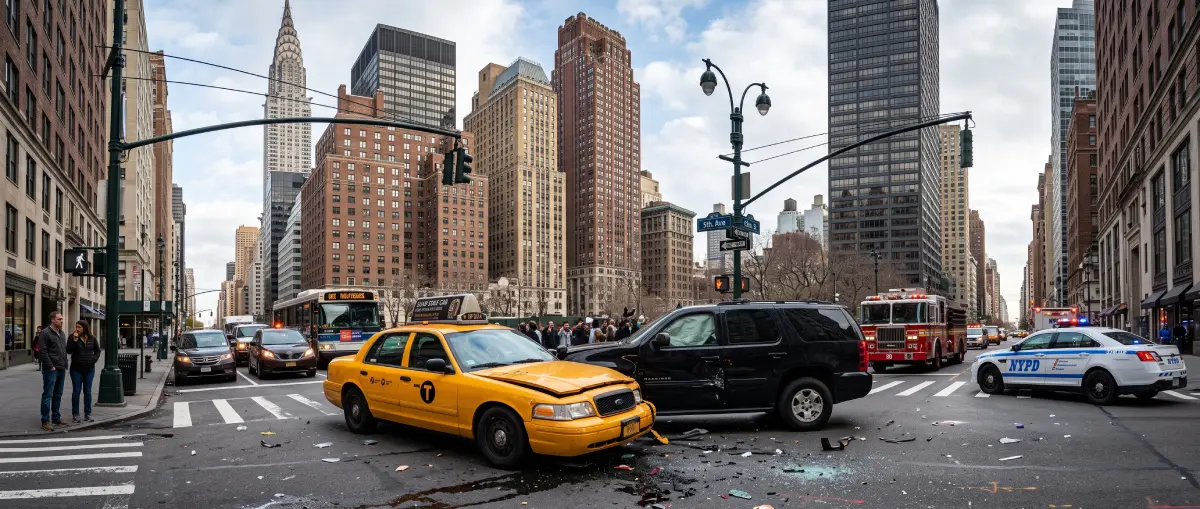
A New York motor vehicle accident lawyer at Silver Law Group deals with the insurance company and the filing deadlines while you focus on getting better. Your first conversation with us is free, in English, Spanish, or Russian.
We pick up the phone 24 hours a day, because a crash does not keep office hours. Everything runs out of one office in Midtown Manhattan, at 49 West 37th Street, and from there we take injury claims across all five boroughs. If an adjuster has already reached you, do not give a recorded statement or accept an offer first. Call 212-470-4544, and we will tell you where your case stands before you commit to anything. If you cannot come to us, the attorney can meet you at your home or in the hospital, and there is no charge to find out whether you have a claim worth bringing.
Do You Have a Motor Vehicle Accident Claim in New York?
A motor vehicle accident claim in New York turns on negligence — proving another driver failed to use reasonable care and hurt you as a result. The law breaks that into four parts you have to show:
- Duty: every driver owes others on the road a duty to drive with reasonable care.
- Breach: the other driver broke that duty by speeding, running a light, following too closely, or driving distracted.
- Causation: that breach is what caused the crash and your injuries.
- Damages: you suffered actual losses, from medical bills to lost income.
New York does not throw out your case if you share the blame. Under CPLR 1411, the state follows pure comparative negligence: your recovery drops by your percentage of fault, but it never disappears. If a jury finds you 30 percent responsible for a collision, you still collect 70 percent of your damages. Even a driver found mostly at fault can recover something.
Insurers know this rule, and they will try to pin as much fault on you as possible in the first days after a crash. That is one reason not to explain what happened to an adjuster before you have talked to a lawyer.
Types of Motor Vehicle Accidents We Handle
New York City recorded 205 traffic deaths in 2025, the fewest since the city began keeping count in 1910, according to NYC DOT. Safer streets still leave tens of thousands of people injured every year, and those injuries come from every kind of vehicle on the road.
We handle claims across the full range of crashes:
- Car and SUV collisions
- Truck and commercial vehicle crashes
- Motorcycle wrecks
- City bus and charter bus accidents
- Rideshare crashes involving Uber and Lyft
- Pedestrian and bicycle collisions
The vehicle changes, but the legal question does not: did someone drive carelessly, and did that carelessness hurt you? Every one of these runs on the same negligence law, which is why one firm can take all of them.
Car Accidents
Car crashes are the most common motor vehicle claim in New York, and the largest share of the cases we handle. Rear-end hits, intersection collisions, and highway pileups all run on the same no-fault and negligence rules that apply to every driver in the state. The causes, the evidence that proves them, and the way insurers value these claims are specific enough that we treat them on their own page.
Truck and Commercial Vehicle Accidents
A truck crash rarely comes down to one driver. The trucking company that employed him, the crew that loaded the cargo, and the shop responsible for maintenance can each carry part of the blame, which means more insurance policies and more parties to hold accountable. Federal rules on driver hours and vehicle inspections come into play too, and evidence like the truck’s electronic logs disappears fast.
Motorcycle Accidents
Motorcyclists get blamed for their own crashes more often than they should. Juries and adjusters carry a bias that riders are reckless, even when a driver turned left across the rider’s path or drifted into the lane. That bias meets a hard fact: with no frame around them, riders absorb far worse injuries than people in cars, from road rash to broken bones to head trauma.
Pedestrians, Cyclists, and Rideshare Passengers
If a vehicle hit you while you were on foot, on a bike, or riding as a passenger, you recover under the same negligence and no-fault rules as any driver. New York’s no-fault benefits reach pedestrians and cyclists struck by a covered vehicle, and rideshare passengers are covered by the driver’s policy and the company’s. You did not need to be behind a wheel to have a claim. The kind of road user you were does not decide whether you can be paid — the other party’s carelessness does.
What Your Claim Could Be Worth
What a claim is worth depends on your injuries and your losses, not on a formula anyone can quote you up front. New York damages fall into two groups.
Economic damages cover money you can add up:
- Medical bills, from the ambulance to surgery to physical therapy
- Future medical care your injury will need
- Lost wages while you could not work
- Lost earning capacity if you cannot return to the same job
- Property damage to your vehicle
Non-economic damages cover the harm with no receipt attached:
- Physical pain and suffering
- Emotional distress
- Loss of the activities and relationships the injury took from you
Here is the catch that surprises most people. Under New York Insurance Law 5102(d), you cannot collect for pain and suffering unless your injury clears the state’s serious injury threshold. That means a defined category, such as a bone fracture, significant disfigurement, permanent loss of use of a body function, or a medically determined injury that keeps you from your normal activities for 90 of the 180 days after the crash. If your injury does not meet 5102(d), no-fault benefits still pay your medical bills and lost wages, but the door to a pain-and-suffering award stays closed. Proving you meet that threshold, with the right medical records behind it, is often what decides a New York motor vehicle claim.
New York’s No-Fault Insurance and MVAIC Coverage
After almost any New York crash, your own insurance pays first, no matter who caused it. This is no-fault, also called personal injury protection, or PIP. It covers your medical bills, a portion of your lost wages, and other reasonable expenses up to your policy limit, and it pays whether the crash was your fault or the other driver’s. The trade-off is that no-fault does not pay for pain and suffering, and it does not require anyone to admit blame.
No-fault comes with its own clock. You generally have to file a written no-fault claim with the insurer within 30 days of the accident. Miss that window and you can lose benefits you were entitled to, so this is one of the first things to handle after a crash.
When the driver who hit you has no insurance, or fled and was never identified, no-fault through your own policy may still apply — and if it does not, the Motor Vehicle Accident Indemnification Corporation, or MVAIC, exists as a backup. MVAIC is a state-created fund that pays qualifying victims of uninsured and hit-and-run crashes who have nowhere else to turn. It carries strict notice deadlines of its own, which is one more reason to move early.
What to Do Immediately After a Motor Vehicle Accident
The hours after a crash shape the claim you can bring later. A few steps protect both your health and your case:
- Call 911 and get a police report. The report locks down the basic facts while they are fresh.
- Get medical care the same day, even if you feel fine. Adrenaline hides injuries, and a gap in treatment is the first thing an insurer uses against you.
- Do not give a recorded statement to any insurance company, including your own, until you have legal advice. Adjusters are trained to get you to minimize your injuries or admit fault.
- Save what you can: photos of the scene and the vehicles, the other driver’s information, and the names of any witnesses.
- Call a lawyer before you talk settlement. Once you have counsel, the insurer deals with your attorney, not with you.
Deadlines to File Your Motor Vehicle Accident Claim
New York injury claims run on more than one clock, and the shortest one can end your case before you know it started.
For most motor vehicle crashes, CPLR 214 gives you three years from the date of the accident to file a lawsuit. That sounds like plenty of time, but building a case, gathering records, and negotiating take months, and evidence fades the whole while.
The deadline shrinks hard when a government vehicle or agency is involved — a city bus, an MTA vehicle, a sanitation truck, or a pothole a public agency failed to fix. Under General Municipal Law 50-e, you have just 90 days from the accident to file a formal Notice of Claim before you can even sue. After that notice, you generally have one year and 90 days to bring the actual lawsuit, far less than the standard three years.
You often cannot tell at the scene whether a public agency is on the hook, so the safe move is to treat every claim as if a short deadline applies and get advice quickly. A missed Notice of Claim usually cannot be undone.
Boroughs We Serve
New York’s injury law is the same in all five boroughs. The three-year deadline, the no-fault rules, and the serious injury threshold do not change when you cross from Queens into Brooklyn. What changes is where your case is filed, which court hears it, how quickly that court moves, and which hospital treated you, and those details shape a case as much as the law does.
We handle motor vehicle claims across the entire city:
- Bronx
- Brooklyn
- Queens
- Manhattan
- Staten Island
A crash on a busy Queens expressway and a crash on a quiet Staten Island side street can raise the same legal questions and still move through very different courtrooms. County caseloads differ, jury pools differ, and the medical records come from different hospital systems.
Our office sits in Midtown Manhattan at 49 West 37th Street, central to all five boroughs and a short trip from the courts where these cases are decided. If getting to us is hard while you are hurt, the attorney can come to your home or hospital room instead.
Why Silver Law Group
Two things matter most when you pick a New York motor vehicle accident lawyer: what it costs you and whether the firm is ready to go to trial.
Cost is simple here. We work on contingency, which means you pay no fee up front and no fee at all unless we recover money for you. Our fee comes as a percentage of the recovery, agreed in writing before we start, and if the case brings in nothing, you owe us no attorney’s fee. That structure lets people who could never write a retainer check bring a serious claim.
Trial readiness is the other half. Insurance companies track which firms actually try cases and which only settle, and they price their offers accordingly. We prepare every case as if it will end in front of a jury, from the first medical record to the last deposition. Most claims still settle, but preparing to win at trial is what makes a fair settlement possible.
You also get free consultations in English, Spanish, and Russian, a phone answered around the clock, and an attorney who will come to your home or hospital room if you cannot travel.
Call 212-470-4544 for a free consultation. No fee unless you recover.